Review of The Lady as Saint: A Collection of French Hagiographic Romances of the Thirteenth Century by Brigitte Cazelles

In this book, Cazelles seeks to determine what defined the concept of female sanctity in the thirteenth century amid the development of new literary forms and their impact on society. By analyzing the text of these “hagiographic romances” and comparing it with other examples of poetic and prose hagiographical accounts, Cazelles seeks to establish the common themes of female sanctity in hagiographic literature of the period. Moreover, by taking into account the authorship and audience of these texts, she also attempts to determine the purpose and effect of these works. Her primary focus is comparing the defining moments and themes of sanctity to conclude what defines female sanctity, and therefore, what example is set for women of the era, who were the primary audience of these romances. 

By including context, analysis, and anthology of thirteen hagiographic romances written primarily in thirteenth-century France, Cazelles holds a strong influence over the reader’s perspective. She organizes her text by giving a brief overview of the sociopolitical structures of France in a broader context as well as the contemporary state of the Catholic Church and the tradition of hagiography in Catholicism and literature. She then introduces her arguments by giving precise, quotation-based examples from hagiographic literature that predate these romances as well as contemporary examples. She compares how prose and poetic hagiographies differed in both origin and emphasis, as well as how both styles of writing treated male and female saints. In general, prose accounts were written for those who could read, especially Latin, while poetic accounts were grounded in oral tradition. They were intended primarily for recitation to the common, illiterate public for their edification. While the literacy rate for this period is an issue up for debate, there is strong evidence that the authors were mostly if not all male. Moreover, she argues that intertextual references make it clear that while these stories are edifying to all, these female saints primarily serve as examples for Christian women to emulate. 

By the thirteenth century, however, the poetic style had changed in light of the rising popularity of courtly love and troubadours’ romantic poetry. It is then that existing poetic versions of Saints’ Lives as well as prose sources were adapted into the hybrid form which is the subject of the book: hagiographic romances. Sometimes they were composed with the epic decasyllabic format of secular and vernacular epics, such as The Song of Roland. More often, however, they followed the octosyllabic pattern which most troubadour romances exemplified. More than formatting, these new hagiographies followed the romances in other stylistic elements as well, whether describing male or female saints. To quote from the text, “The Romance [of Saint Alexis] focuses on human emotions in a manner reminiscent of courtly romance, thus greatly reducing the importance of the salient motifs (such as flight from society and holy insensitivity) that characterize the earlier version” (32). Focus shifted from pure piety to emotional language. Moreover, Cazelles gives many examples of a shift to physical and sexual themes in these thirteenth-century hagiographic romances, especially in those featuring holy women.

Cazelles posits that the predominant distinction between male and female sanctity as portrayed in this format is grounded in the body. In hagiographic romances, male saints transcend the body, while female saints are defined by it. According to Cazelles, “Female Saints’ Lives of the vernacular verse production in the main stress the exemplary character of their protagonists’ achievement in terms of an exceptional, and virtually inimitable, ability to overcome woman’s innate propensity to sin in the flesh” (34). She uses the examples of Catherine of Alexandria, Margaret of Antioch, and Mary the Egyptian, who were all popular subjects of hagiographic verse in the previous century, to delineate the differences between earlier depictions of female saints to those of the thirteenth century. In new hagiographic romances, the physical sufferings which constitute their holiness are brought on by their beauty and their resistance to sexual temptation or advances.

While Cazelles acknowledges that women were able to rise to a state of recognition and exultation in the courtly love tradition, she argues that female characters were still limited to the role of a symbol rather than an active participant. She argues that while the holy woman is not as limited as the beloved woman, she is still “marginalized and set at a distance from the sphere of cultural activities” by the motif of virginity, which is paramount to the portrayal of saints in the anthology provided (47). She goes on to illustrate and argue how exposure and enclosure as themes in these hagiographic romances further amplify the “erotic elements inherent in these stories” (63). She also addresses the role that erotic language plays in the writings of Christian mystics. However, she argues that these romances are not personal testimony, but “images that reflect a male perspective on women’s piety and perfection” (70). She concludes that material suffering is the price of female salvation and sainthood, specifically in terms of self-sacrifice. She does this in life by preserving her chastity and in death through martyrdom. Even after death, Cazelles argues, she is not a person, but a source of miraculous power.

Cazelles’ argument is layered and multifaceted, and she builds to her points effectively and convincingly. As mentioned previously, she structured the book to support her arguments as well, providing first a general background, then her arguments, and lastly the brief anthology. This order suits the goal of the text, and it supports her argument internally. Furthermore, the thorough construction of her argument provides specific examples illustrating each point. However, I do not think the book or her argument is without its weaknesses. Her critiques are based around the idea that these hagiographic romances were meant to represent sanctity but were stylized to please crowds. However, she does not go into detail about the context in which these hagiographic romances would be recited. I can make assumptions based on knowledge of the veneration and celebration of saints, but the gap raises questions. Could these texts have served as popular entertainment or literary exercises? What evidence is there of their purpose and use, besides that given by the poems’ authors, which Cazelles points out to be unreliable at times (33)? Another flaw I find is that while her argument is convincing, I think some of her analysis is too influenced by a modern perspective. In all her analysis, she gives little evidence of contemporary thoughts on the matter. The female authors whom she cites as contemporary evidence do not match the intended audience that she had previously described, having argued the illiteracy of the common woman. Moreover, the examples Cazelles cites are based on her analysis of their writings, not a firsthand response. If there is not one, that should be acknowledged. 

Overall, however, I do believe Cazelles provides a well-written and researched argument. 

Cazelles, Brigitte. The Lady as Saint: A Collection of French Hagiographic Romances of the Thirteenth Century. Philadelphia: University of Pennsylvania Press, 1991. JSTOR. https://www.jstor.org/stable/j.ctt130jv0n.6
Research Assignment 4.0: A Sheepish History of Saintly Representation

For this assignment, I have chosen St. Agnes, not only because I am most familiar with the story of her martyrdom, but also because her canonization and thus widespread veneration. Though Agnes does not have a cult in the same manner that many other saints do, she has still inspired many artist to immortalize her their depictions.

Because this article will be focused on Agnes’ depictions, please view my earlier posts for a more complete summary of Agnes’ martyrdom. Below I will attempt to illustrate the common themes found in images of Agnes through these images. Their sources I will include.

An Incomplete Timeline of Examples

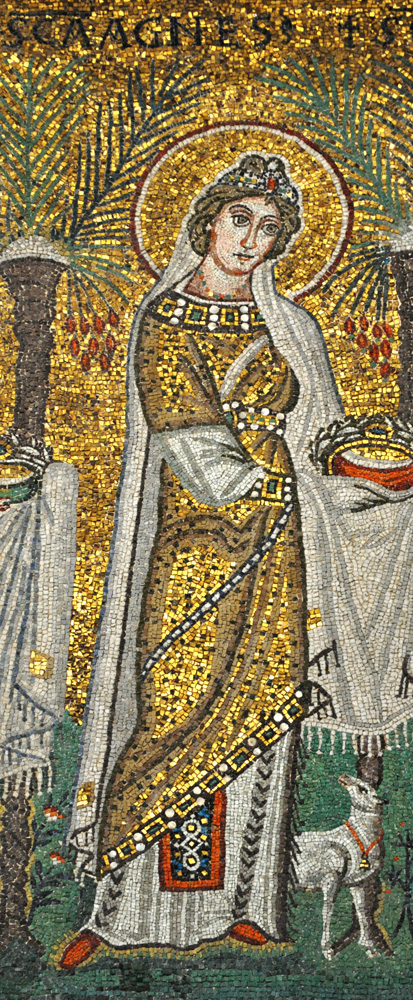
The earliest piece of artwork that I could locate dates back to the sixth century.

agnesApNuovo.html.jpg
Sant’Apollinare Nuovo, Left Nave, Procession of Female Saints: Agnes

This image is taken from a large mosaic on the left wall of the nave of Sant’Apollinare Nuovo, in Ravenna. Agnes is accompanied by a lamb, a symbol that will follow her in almost every rendering I could find.

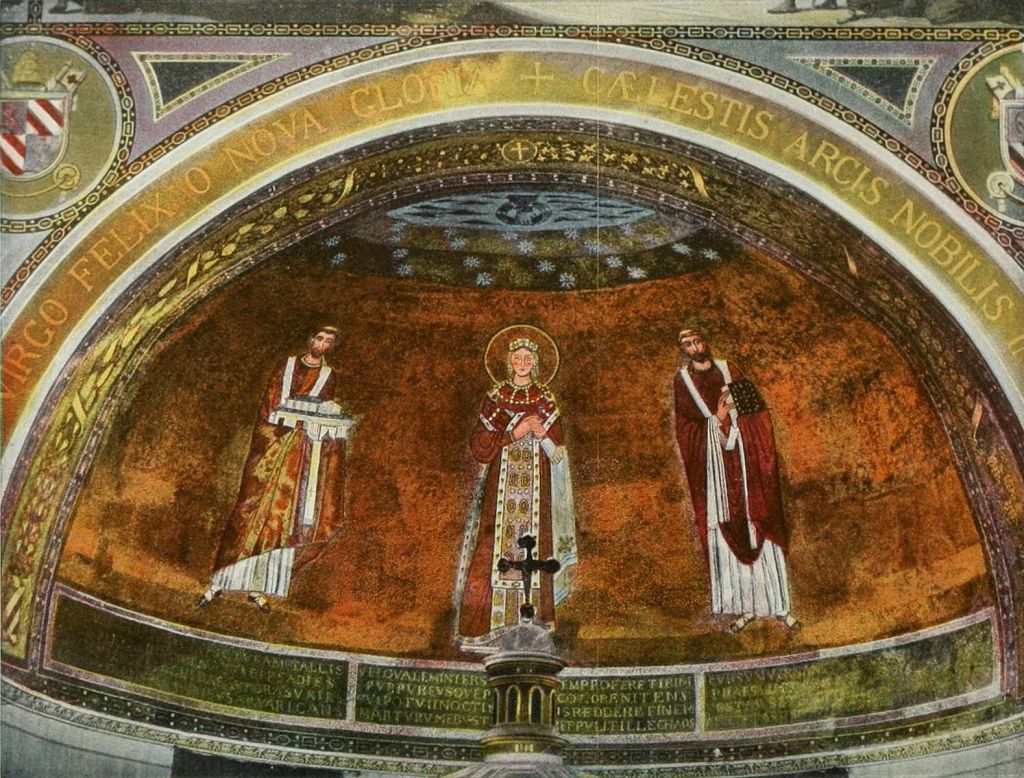
Next, I located this mosaic, which traces back to the 7th century.

Saint Agnes, Mosaic, Sant’Agnese Fuori le Mura, c. 7th century
The same mosaic of Saint Agnes, showing Pope Honorius I and another Pope on either side.
Honorius is most likely the Pope on the left, pictured with a miniature of a church, because he commissioned its building.

These mosaics belong to the apse of Sant’Agnese Fouri le Mura, or Saint Ages Outside the Walls. This church is built atop the catacombs where St. Agnes’ remains are said to be housed, with the exclusion of her skull. Her (purported) skull is housed in the church of St. Agnes Agone, a 17th century church inside the city walls. Notably, this depiction does not include the most common symbol that accompanies St. Agnes, her lamb.

Unusually, I had an incredibly difficult time finding work between this period and the 14th century. Those which I did find were not of a licensure I could share, or the image was so poor that it was not worth including, as nothing could be analyzed from it. Thus, onto the next notable specimen.

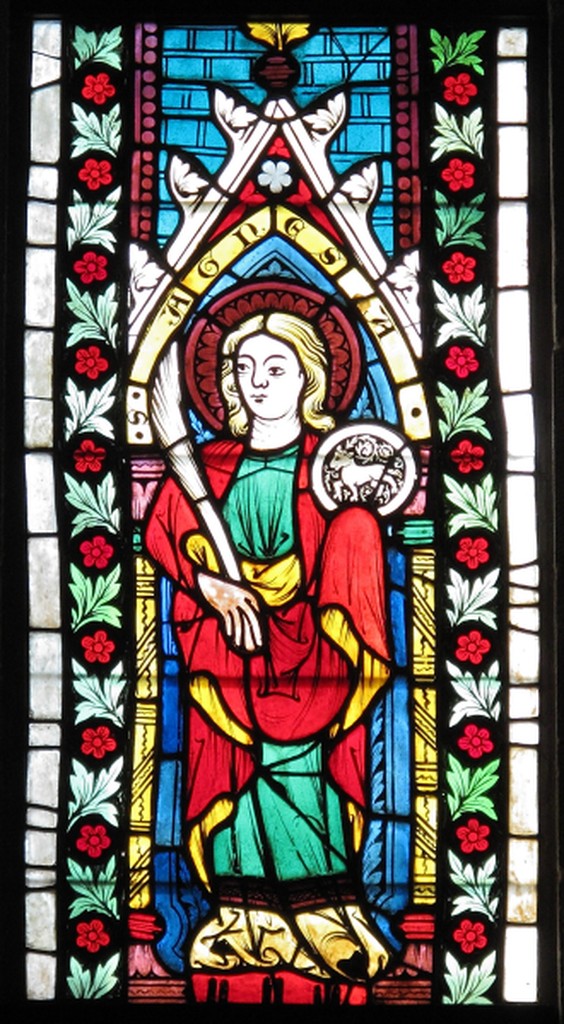
Saint Agnes in Stained Glass, Carinthia, Austria, c. 1340-50, now housed at the Metropolitan Museum of Art

In this stained glass window, originally produced c. 1340 in Carinthia, Austria, Agnes is pictured with a variation on her lamb theme which appears in several productions of her image. Here, the lamb appears as if it is on a medallion or plate, rather than in her hands. I was not able to find any reasoning besides stylistic as to why the lamb might be portrayed in this way. For lack of a better term, I shall refer to is as the “medallion of the lamb”. In her other arm, she carries the traditional palm frond that symbolizes martyrdom.

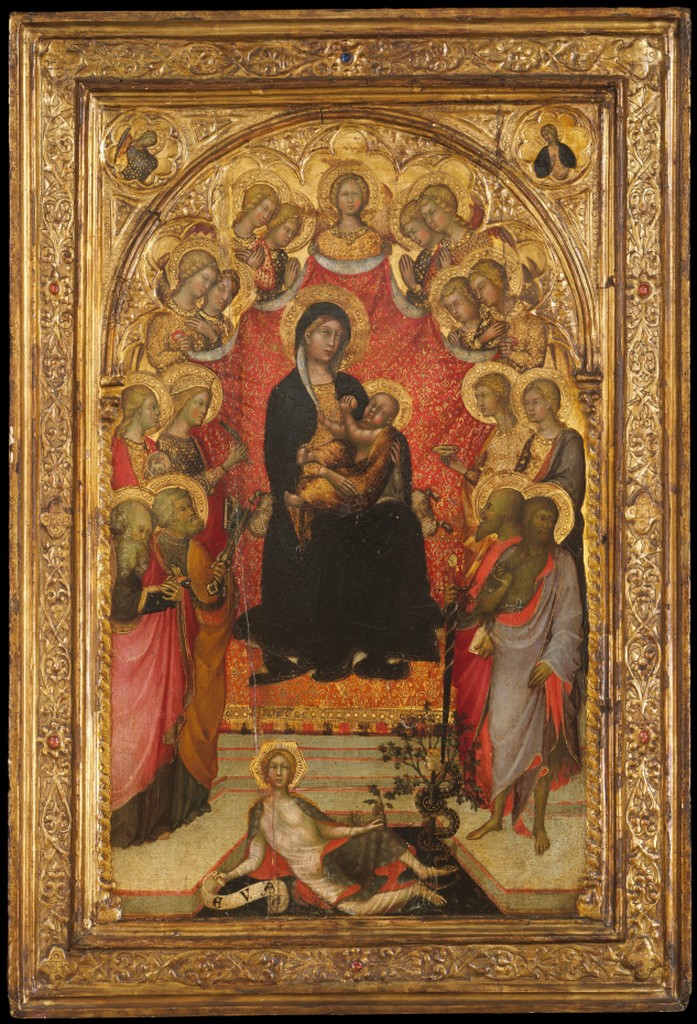
Madonna and Child Enthroned (et. al) by Paolo di Giovanni Fei, San Quirico, Italy, c. 1385-90

This painting has a great deal going on besides just St. Agnes, who peeks in on the left side in a pink-red robe holding a small medallion of a lamb once more. Here, all the saints portrayed carry some sort of artifact or marker which identify them as Saint John the Evangelist, Saint Agnes, Saint Peter, Saint Catherine of Alexandria, Saint Lucy, Saint Paul, and Saint John the Baptist, with the exclusion of the remaining female saint that is not identified. However, I included it because it shows that once again, St. Agnes is known by her lamb.

Martyrdom of St. Agnes by Vincente Masip, Spain, c. 1540-45

This painting brings forth a more graphic image of the saint; this artist chose to portray the gravitas of her martyrdom. A guard draws her close to slit her throat after burning her at the stake has failed. The crowd is tumultuous. Above, angels wait with a crown for the soon-to-be martyr to welcome her into heaven. And what does she clutch close to her? Not a relic from her vita, but her identifying lamb — an artistic touch to further illustrate who this martyr is: Agnes.

Saint Agnes by Giovanni Battista Moroni, Italy, c. 1576, now housed in the Columbus Museum of Art

This pastoral scene is one of many that depict St. Agnes in pink robes, holding her lamb in repose. It appears she is sitting amongst Roman ruins, but it is unclear if she is at peace or saddened.

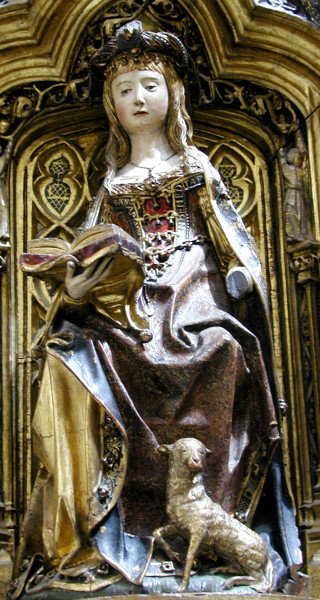
Altarpiece of St. Agnes, Chapel of the High Constable, Burgos Cathedral, Spain, 16th century

This alterpiece, found in a chapel within Burgos Cathedral in Spain, dates to the 16th century. St. Agnes is depicted with a book, most likely representing Scripture. She also is unusually dressed in what would have been a period gown for 16th century Spain, but not a Roman martyr. Never fear — she is still accompanied by her token lamb.

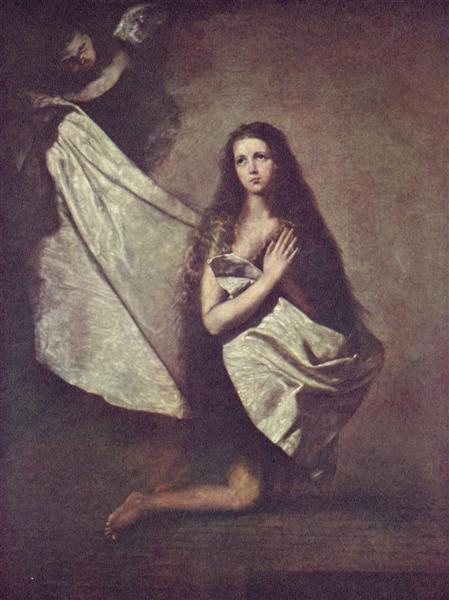
St. Agnes in Prison by Jusepe de Ribera, Naples, Italy, 1641

This painting depicts the darker side of Agnes’ tale once more, as well as one of her miracles. In suiting to one of the prominent versions of the account of her persecution, the painting depicts a man snatching away her covering, hoping to shame the chaste woman with nakedness. However, her hair appears to be growing, as it does in the story, covering her and preserving her modesty. This is a rare example without her lamb, but perhaps the iconic tale of her miraculous hair speaks for itself.

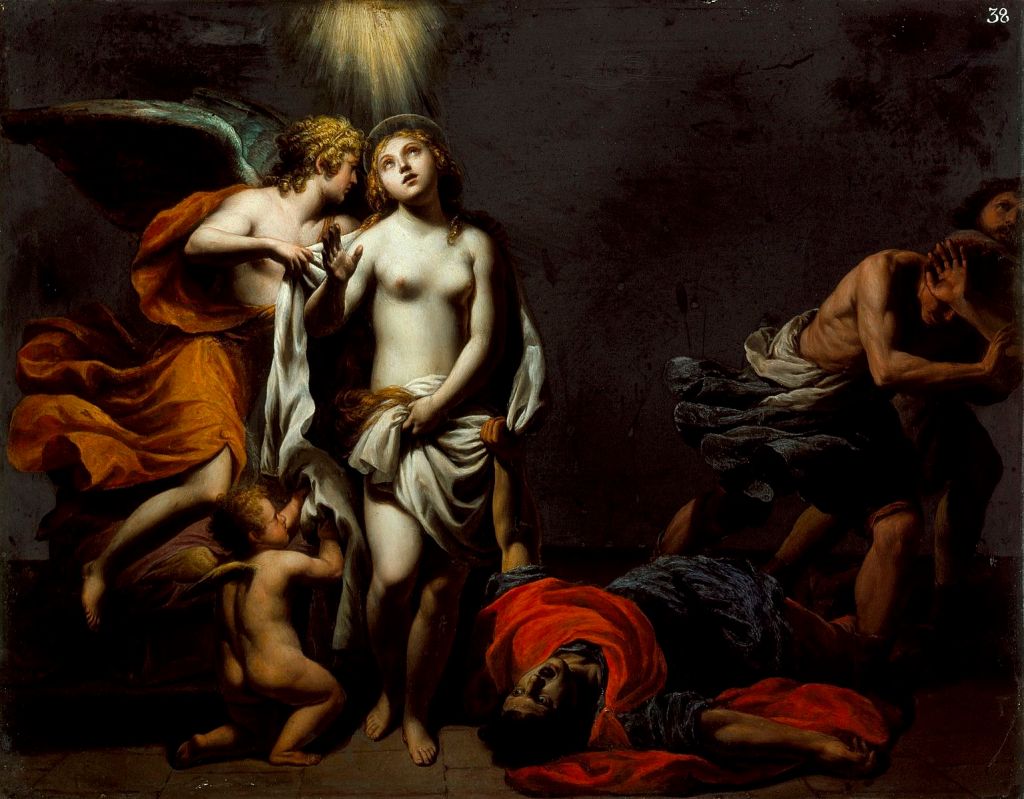
Saint Agnes Protected by an Angel by Alessandro Turchi, c. 1620

In this painting, St. Agnes is partly exposed by her attackers. However, rather than merely miraculously growing long hair, two angels protect and help clothe Agnes. Meanwhile, the men which had attempted to violate her flee, or, as in the case of the man on the ground, are struck down and blinded. Both the tale of the blinding and her long hair — which does appear to reach past her waist where it peaks out of the shadow of the sheet — suit the commonly accepted events of her vita.

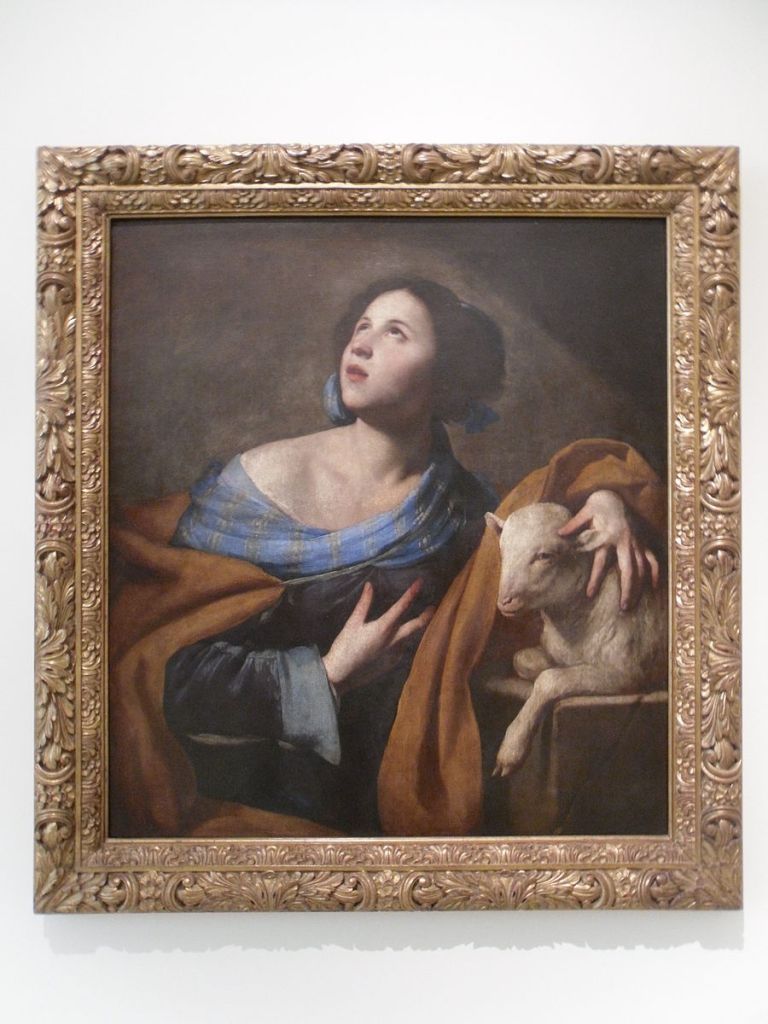
Saint Agnes by Massimo Sanzione, 1635
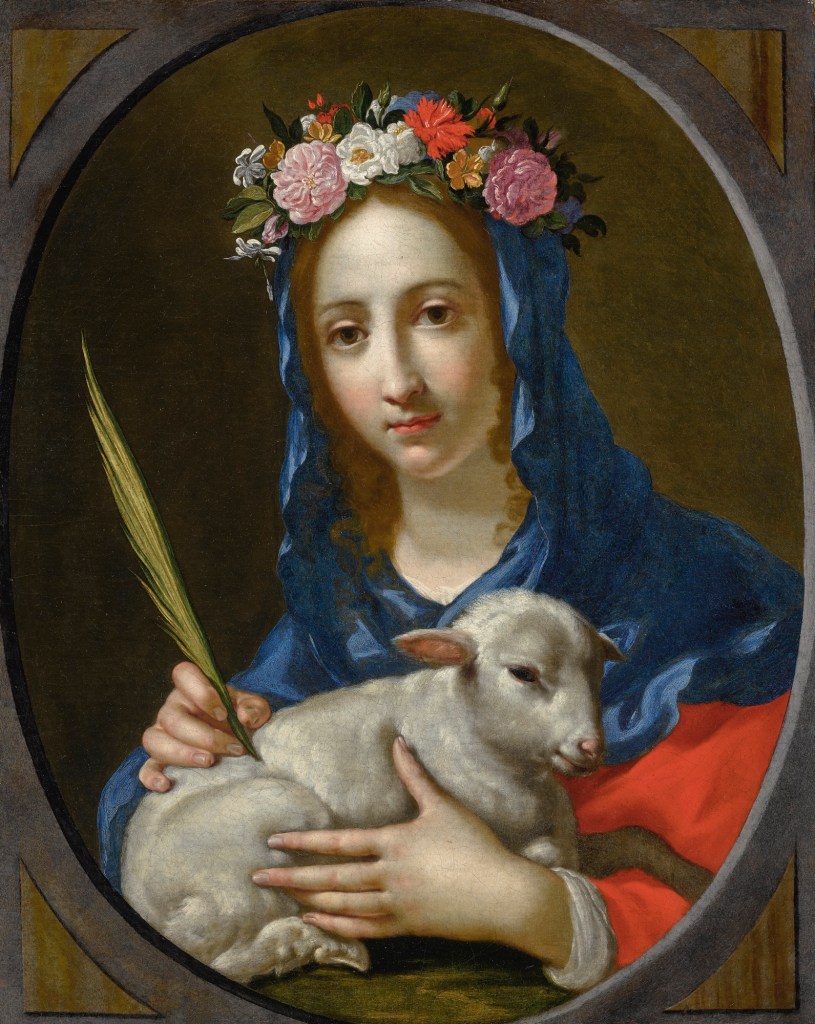
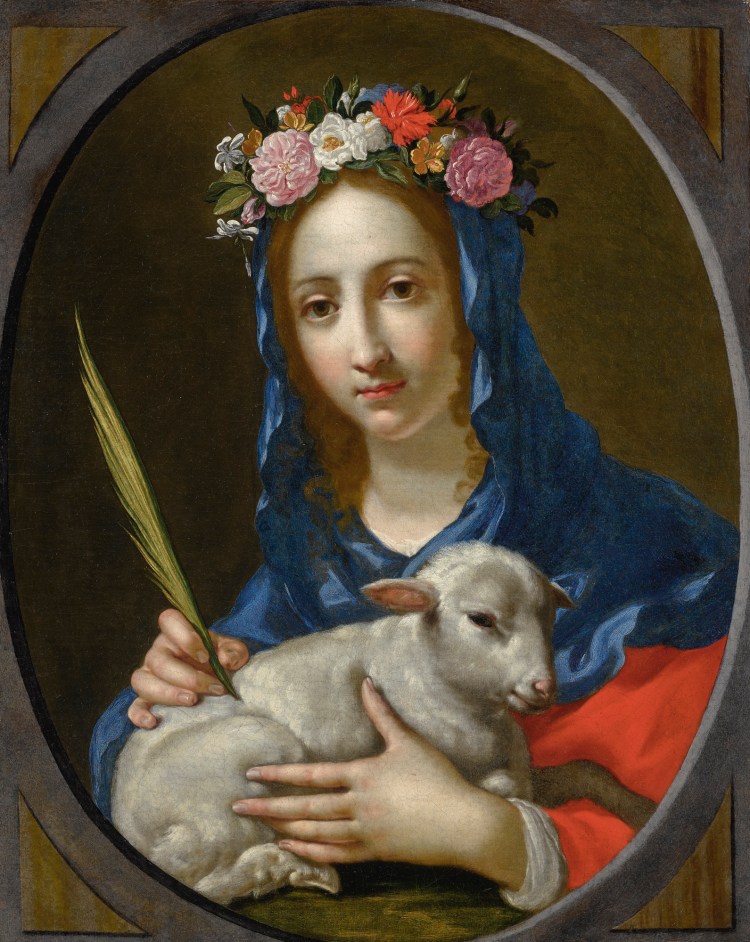
Saint Agnes by Cesare Dandini, early mid-17th century

I grouped the three of these images together because with some variation, they illustrate the similarities of Agnes’ portrayal. The first, c. 1620, adds the elements of angels bestowing a crown and palm branch of martyrdom upon her. The second is more simplistic, as is the third. The second is the only one without the martyr’s palm, but all three have the continuous theme of the lamb.

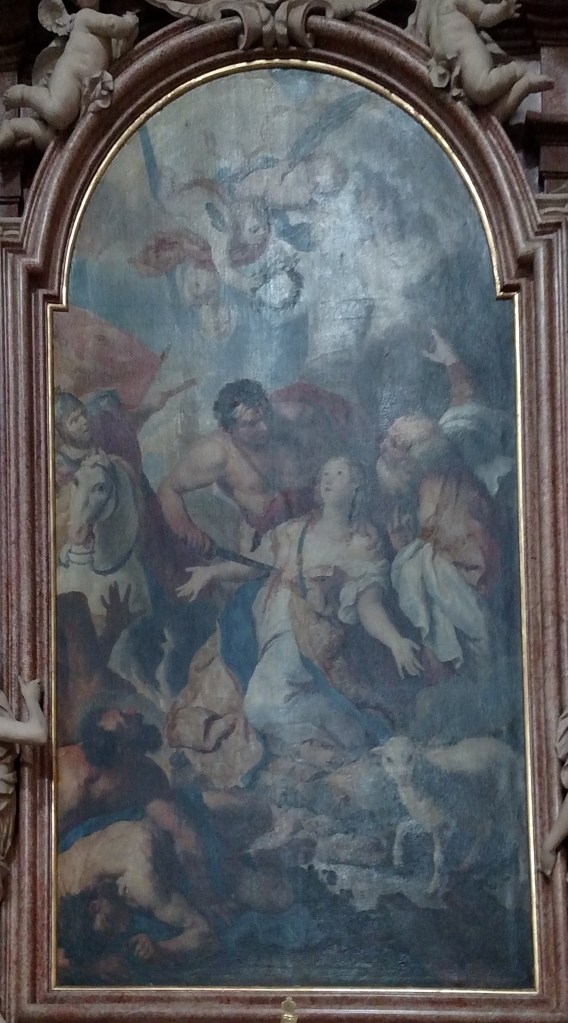
Fresco of the Martyrdom of St. Agnes, artist unknown, Cathedral of St. Stephen, Passau, Germany, c. late 17th century

This image is not ideal in quality, but I wanted to include this unique fresco. Once more, we have a portrayal of St. Agnes’ martyrdom, with many details from her legends. The man in the lower left foreground may be the one struck down and blinded. There is what appears to be charred wood in the lower right corner, most likely her failed pyre. Above Agnes, angels descend to bring her a wreathed crown, and on the right, there is also the classic editorial addition of Agnes’ lamb. What is interesting about this version is that the executioner appears to be cutting her in the side, rather than her neck, differing from the traditional account. The author of the article I found this image in posits that this is because the artist wanted to draw a parallel between her wound and the wound in Christ’s side.

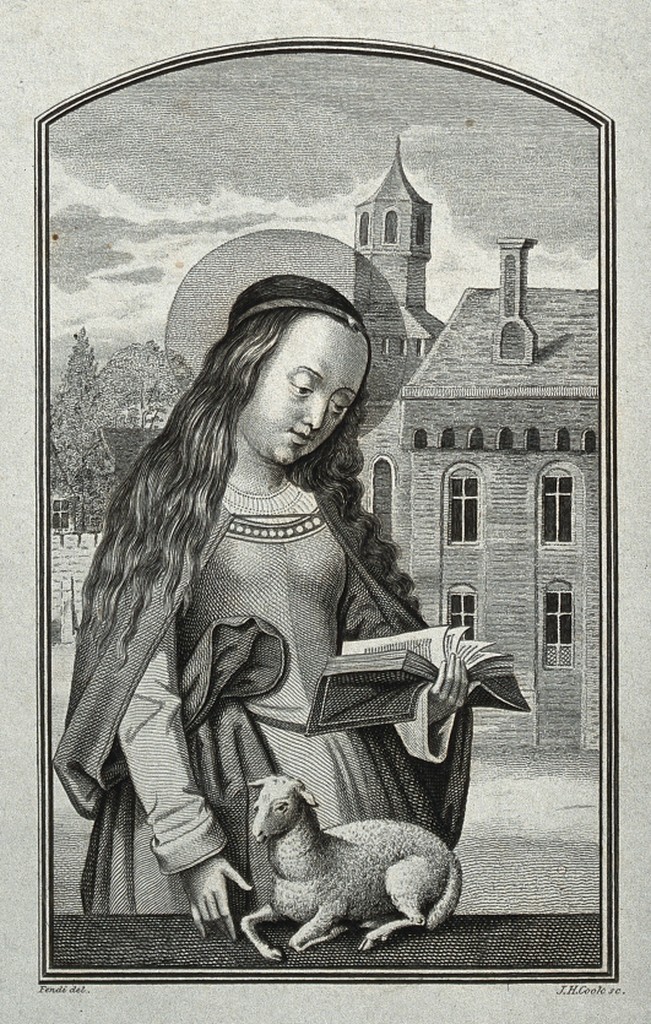
Saint Agnes engraving by J. H. Cook after P. Fendi, 1821

To close this perusal, I wanted to provide one more “standard” St. Agnes. Here she is pictured with her lamb, as usual. She also has a book of what is mostly likely Scripture. She appears younger than in most previous renditions, and her dress is not period-appropriate for a Roman citizen at the turn of the fourth century. However, these discrepancies aside, this is a strong example of the commonality of most Agnes portrayals — peaceful, focused on holy matters, and accompanied by a lamb.

For the sake of avoiding further redundancy, I will close this foray into the art history of Saint Agnes.

Agnes Had a Little Lamb: Closing Remarks

Saint Agnes has been portrayed in several ways over the centuries, though predominantly consistent with either the stories that surround her life, or consistent with the standard combination of Agnes and her sheep.

Why is Agnes so frequently portrayed with a sheep, especially if it did not feature in any of her vitae accounts? There are a few theories. Lambs are frequently associated with purity, and she is the patron saint of chastity and young women, among others. The lamb is also a symbol closely associated with Christ, as the Lamb of God, and a symbol of sacrifice that dates back to the Old Testament. It may then harken to her sacrifice as a martyr for Christ and her closeness to Him because of her righteous devotion.

However, the predominant theory seems to be that the connection may have been drawn because of her name. The Latin word for lamb is “agnus”, which developed from the Greek ἁγνή (hagnē), meaning “chaste, pure”. Thus, the sight of the lamb would connect the viewer to the name Agnes and to her chastity, for which she was martyred.

Altogether, this has been an interesting adventure down the art history rabbit hole, and a nice time revisiting my friend, St. Agnes.

Additional Basic Info Source: https://en.wikipedia.org/wiki/Agnes_of_Rome

Further Tangential Reading (which did not have images I could incorporate and thus, sadly, did not fit this assignment): St Agnes of Rome as a Bride of Christ: A Northern European Phenomenon, c. 1450-1520, by Carolyn Diskant Muir

Research Assignment 3.2: A Bibliography of Secondary Sources

Image result for The Church of St. Croix orléans
https://commons.wikimedia.org/wiki/File:Orléans_-_cathédrale,_extérieur_(18).jpg

Now, having mapped out a few different key points to search for in the databases, I will create a bibliography of secondary sources to compile the 10-15 most relevant academic texts on the history and sanctity of the l’Église de Sainte-Croix. Because I am focusing on what may have attracted pilgrims to this site in the 12th century, when the Liber Sancti Iacobi was published, I have tried to keep my sources as relevant to this time period and before, rather than including sources that deal with the latter portion of the history of the Cathedral of Sainte-Croix.

(This is to say, I sifted through many, many pages full of sources concerning Joan of Arc in order to find what I present here.)

Bibliography

Baert, Barbara. Translated by Lee Preedy. A Heritage of Holy Wood: The Legend of the True Cross in Text and Image. Leiden, Netherlands; Boston, USA: Brill, 2004. Found in part on Google Books. https://books.google.com/books?id=vVcRd2sldBIC&printsec=frontcover&source=gbs_ge_summary_r&cad=0#v=onepage&q&f=false

Barbier, Paul. “Histoire de Saint-Euverte,” 1898. https://search.ebscohost.com/login.aspx?direct=true&AuthType=shib&db=edshtl&AN=hvd.32044087863049&site=eds-live.

Bonser, Wilfrid. “The Cult of Relics in the Middle Ages.” Folklore 73, no. 4 (1962): 234-56. http://www.jstor.org/stable/1258503.

De Certain, Eugène. “ARNOUL ÉVÈQUE D’ORLÉANS.” Bibliothèque De L’École Des Chartes 4 (1853): 425-634. http://www.jstor.org/stable/42994272.

Halfond, Gregory I. “Episcopal Service to the Court.” In Bishops and the Politics of Patronage in Merovingian Gaul, 28-62. Ithaca; London: Cornell University Press, 2019. http://www.jstor.org/stable/10.7591/j.ctvfc540r.7.

Krochalis, Jeanne., Alison. Stones, Annie. Shaver-Crandell, and Paula Lieber. Gerson. The Pilgrim’s Guide: A Critical Edition, 1998. https://search.ebscohost.com/login.aspx?direct=true&AuthType=shib&db=edshtl&AN=mdp.39015049668851&site=eds-live.

Marcel, Aubert. “Cryptes de Saint-Aignan et Saint-Euverte d’Orléans.” Bulletin Monumental, no. 1 (1908): 172. https://search.ebscohost.com/login.aspx?direct=true&AuthType=shib&db=edsper&AN=edsper.bulmo.0007.473x.1908.num.72.1.12523.t1.0172.0000.8&site=eds-live.

Marti, Berthe M. “Hugh Primas and Arnulf of Orléans.” Speculum 30, no. 2 (1955): 233-38. doi:10.2307/2848472.

Melczer, William et al. “A Dictionary of Saints.” In The Road to Compostela, 356-411. New York: Italica Press, 2006. doi:10.2307/j.ctt1t89k0x.18.

Melczer, William. The Pilgrim’s Guide to Compostela, 83-228. New York: Italica Press, 1993. http://www.jstor.org/stable/j.ctt1t88vk4.8.

Renaud, Geneviève. “Les Traditions de l’église d’Orléans Sur Ses Saints Évêques Euverte et Aignan. Vie, Miracles, Culte.” École Pratique Des Hautes Études. 4e Section, Sciences Historiques et Philologiques, no. 1 (1973): 745. doi:10.3406/ephe.1973.5680

Szövérffy, Joseph. “‘Crux Fidelis…’ Prolegomena To A History Of The Holy Cross Hymns.” Traditio 22 (1966): 1-41. http://www.jstor.org/stable/27830805.

Tada, Satoshi. “The Cult of St. Anianus in the Carolingian Period.” The Catholic Historical Review 91, no. 3 (2005): 423-37. http://www.jstor.org/stable/25026881.

Concluding Thoughts and Next Steps

I have located several useful texts here which provide both historical context for the broader understanding of what drew pilgrims and patrons to l’Église de Sainte-Croix. However, I had more difficulty than I expected locating them. I believe I will need to experiment with even more key phrases (having exhausted all forms of Saint Euverte, Cathedral d’Orléans, the True Cross, etc.), perhaps in more languages. There is (understandably) a lot of scholarship on the topic in modern European languages, several of which I included above. However, I have a feeling that there is more information available online that I have yet to locate. Perhaps digging into these texts and their citations will guide me to more sources. I will also play around with the language in which I am conducting my searches to include more of these European scholars.

Research Assignment 3.1: A Cult Site on the Camino de Santiago

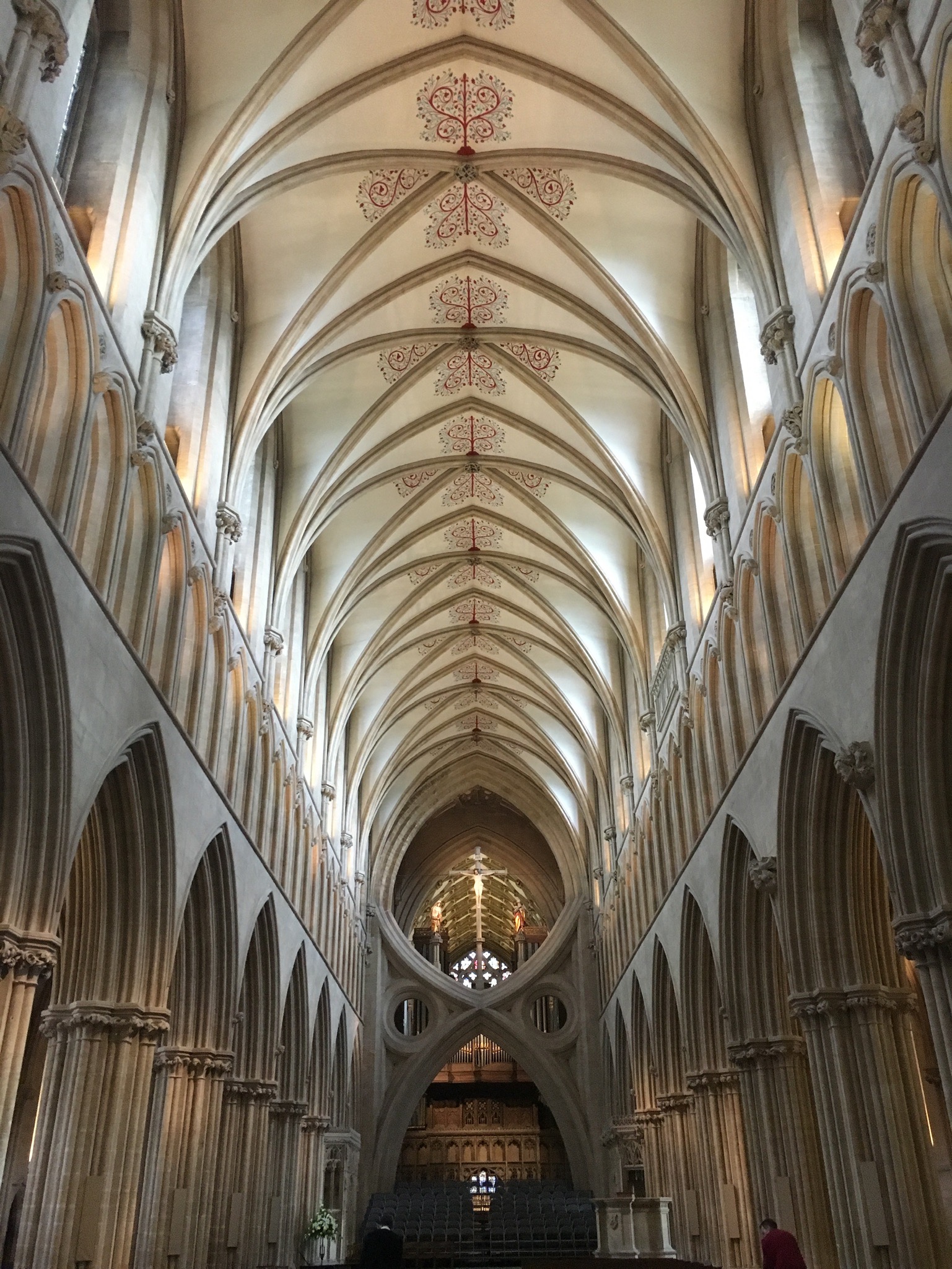
File:Orleans - Cathedral int 01.jpg
https://commons.wikimedia.org/wiki/File:Orleans_-_Cathedral_int_01.jpg

After reviewing the Liber Sancti Iacobi, I decided to focus on the Church of the Sacred Cross in Orléans, also known as l’Église Sainte-Croix in French. The church is noted in the text for hosting the True Cross and the chalice of St. Evortus, a bishop and confessor, though the church does not contain his remains.

To begin, I will create a summary of the sources from which I will draw. Then, I shall present a brief history and description of the church.

A Short Selection of Sources

Starting with Google, I found several sources that fall into three major categories: encyclopedic, travel information, and stock image sites.

To streamline the process, I am only listing a few of the travel sites, because they become repetitive and contain less relevant information. Moreover, the sites that are selling usage of stock images of the cathedral are of no use to me, so I am omitting them.

Encyclopedic

Orleans Cathedral – Wikipedia

Orleans Cathedral – Ancient History Encyclopedia

Sainte-Croix Cathedral | cathedral, Orléans, France | Britannica

Orleans | History, Geography, & Points of Interest | Britannica

Travel Sites

Orleans Cathedral of Sainte-Croix, history and visitor information

Basilique Cathédrale Sainte-Croix d’Orléans, France

Orleans Cathedral | France – Loire Valley

Having reviewed the most pertinent information from these sources, I will summarize the at-hand knowledge a casual student may encounter.

The History of Church of the Sacred Cross at a Glance

The site of the Cathedral of St Croix was originally home to a 4th century Christian church, from the early days of Christianity in France. Accounts vary, as some claim that the church there was built around or before 340 AD, while other believe it was constructed in 375.

Those who promote the 375 date attribute its building to St. Euverte (the same saint called Evortus in the LSI ). According to tradition, St. Euverte saw a vision in which the hand of God appeared in the sky to bless the church on its founding. The symbol of God’s hand can still be seen on the keystone of the chancel ceiling.

Others who promote the earlier date claim its connection to Saint Helena, mother of Constantine, who is traditionally connected to the discovery of the True Cross, a piece of which she donated to the church in its early days. This is one of a few theories as to the origin of the church’s name.

Another is that Charlemagne gifted a piece of the True Cross in the 9th century to Theodulf, the Bishop of Orleans. Archeological evidence points to the church having had ties to the True Cross centuries before, however. Evidence also shows that before Christianity arrived in the region, this sacred spot may also have been home to a Roman pagan temple.

The Cathedral contains many unique items and architectural pieces that remain despite its many redesigns. A wall from the fourth century church is found on the north side of the cathedral. In the fifth century, that church was replaced by a basilica. In the eighth century, a large floor mosaic was added to the crypt, which can still be seen today. The church was rebuilt again in the 9th century, impressively enough to host the coronations of Charles the Bald (848) and King Odo of West Francia (888). The next year, the cathedral and most of the city were destroyed by a fire.

However, Hughes Capet, King of the Franks, ordered that a new Romanesque cathedral would be built on the spot, and it was completed under his son’s reign c. 1000. It was added onto over the next century, but in the 13th century, it partially collapsed. The rebuilding began in 1287, but because of interrupting wars, this iteration would not be completed for over 150 years. However, in 1429, records show that Joan of Arc attended Mass in the cathedral during the English siege. Her attendance, heroism, and connection to Orléans overall creates a strong connection between her history and that of the church.

The new cathedral, in the Gothic style, was finally completed in 1530. However, it took great damage during the protests of the Huguenots in 1568. It was repaired and restored to glory, with other additions and partial, stylistic rebuilding projects over the centuries. However, the church was badly damaged during World War II, with the two front towers and many of the stain glass windows taking extensive damage. Once more, the cathedral was repaired, and it is still painstakingly maintained today.

Next Steps

With a cursory view of the history of this place, as well as a few notes on interesting points worth looking into further, such as the history of the chalice, the crypt, and the True Cross. Next, I will conduct research into the academic sources found in the library databases!

Research Assignment 2.1

Finding a Translation: Through Helen and High Water

For my next research assignment, I was given the task of researching and locating the translatio of a saint not directly discussed in class. After reading through the indexes of both Geary’s Furta Sacra and Bartlett’s Why Can the Dead Do Such Great Things?, I landed on the story of Saint Helen Imperatrix, also known as Sancta Helena Augusta. Helena was the mother of Emperor Constantine, the (supposed) Christian converter of the Roman Empire. Moreover, she remembered for her own pilgrimages and the relics that she procured in the Holy Land — most notably, the True Cross. Thus, St. Helena is a greatly studied figure for her connection to her son as well as her generosity to the Church. She is venerated not only in the Roman Catholic Church, but also the Anglican Church, Eastern Orthodox Church, and other denominations.

For clarity, I shall refer to her as St. Helena henceforth, as there are multiple Saint Helens and Helenas, but her additional title of Augusta, bestowed upon her by her son during her lifetime, distinguishes her.

Geary describes Helena’s translation thus: “In the 840’s a monk of Hautvilliers goes to Rome and secretly removes the body of Helen and re- turns to his monastery with it.”

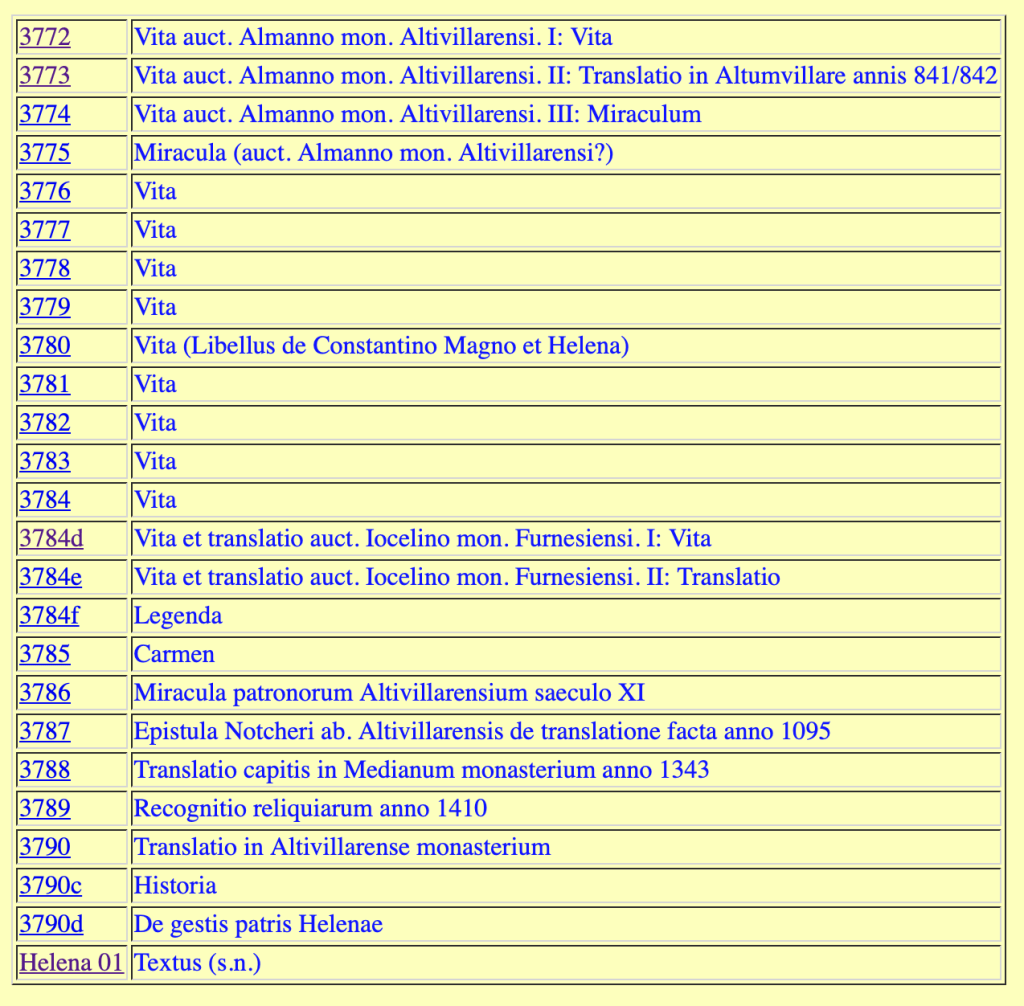
Using the BHL, I located the earliest texts of Helena’s life and her translatio to Hautvilliers, though there are later accounts of different translatios however.

The most pertinent entry was thus:

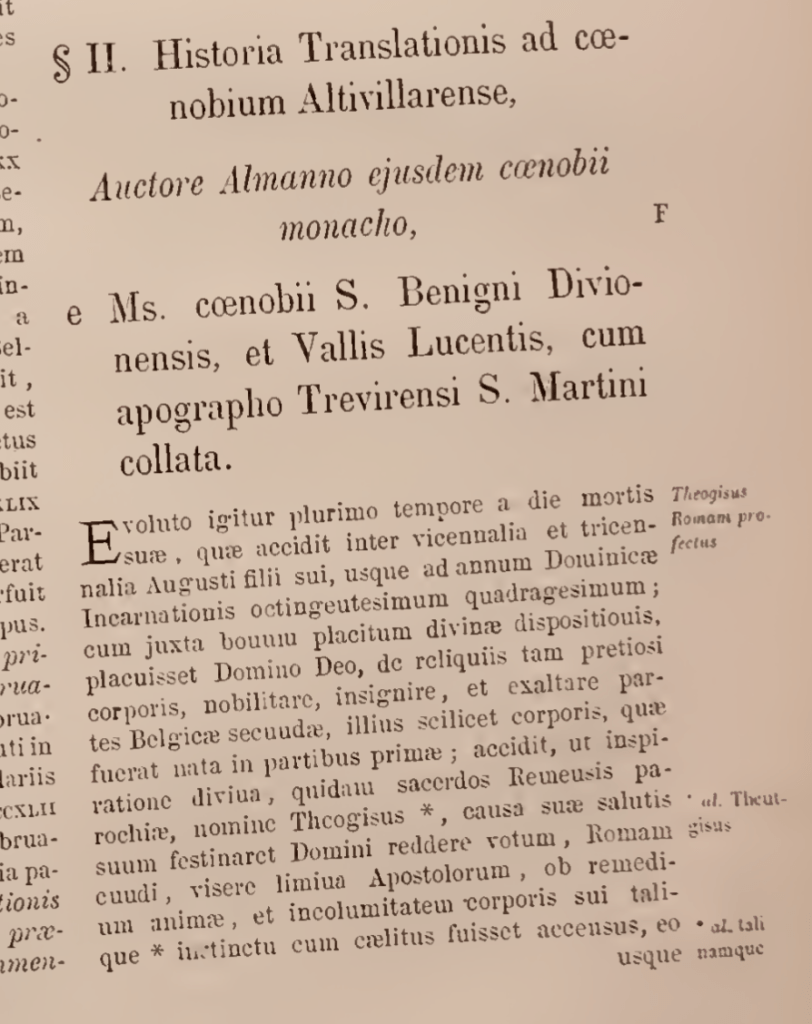
Using the reference provided by Geary and the information about the text’s author, Almannus (sometimes written as Alman or Altman in other texts), I sought to locate the translatio account in the Acta Sanctorum.

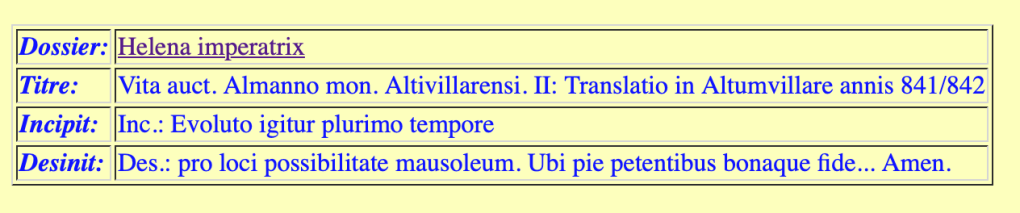
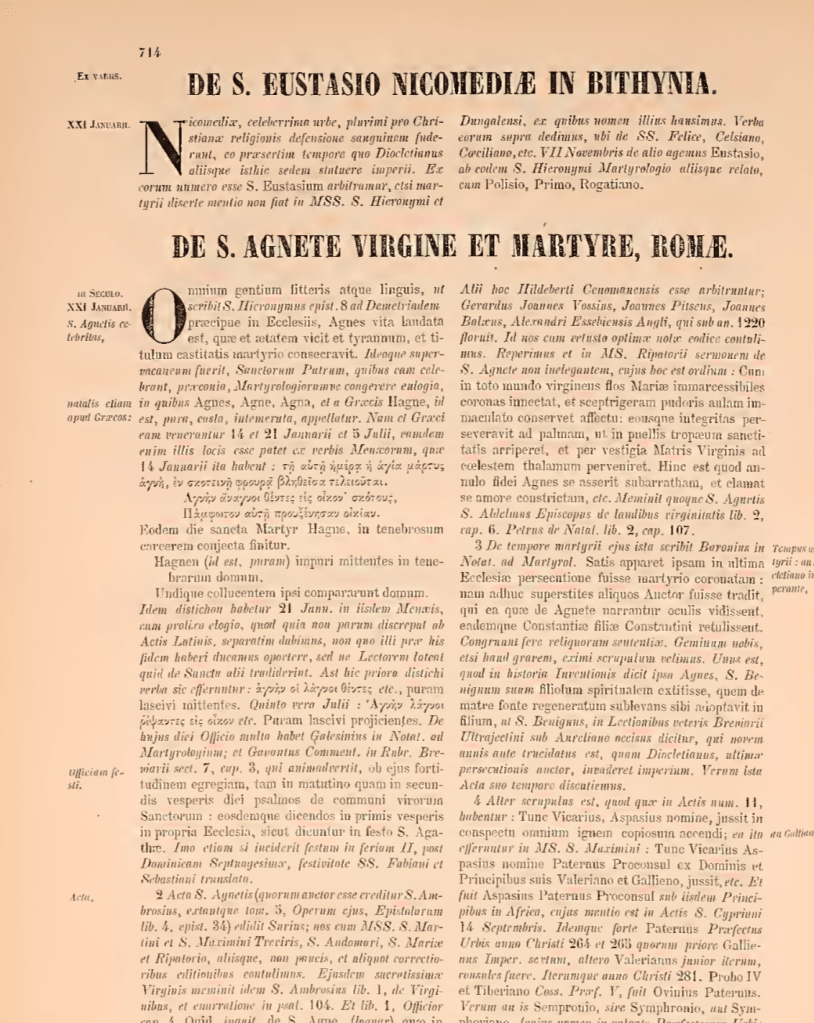
I located Helena’s entry in the third volume of the month of August in the AASS. Her feast day is August 18th, and her entry is very long. The first translatio account alone comprises eleven pages, with the rest of her entry totally more than 100 pages. Regrettably, I was not able to find an English translation of the original translatio account by Almannus. My attempts to find an unbroken piece of text to effectively translate was also moot, despite forays into Spanish, French, and Latin studies on the text.

Here, I include a picture of the beginning of the translatio — note the authorship!

Even so, despite defeat, in my research to find the original text in a translation that I could work with, a later account by Jocelin of Furness. His account, according to specialists on the topic of Helena (see bottom of page), is near to Almmanus’ account, and likely based on a secondary account which summarized Almmanus’ text. This text, which also includes Jocelin’s vita of Helena, was translated by Ingrid Sperber and Clare Downham as part of a larger project entitled “Hagiography at the Fronteirs: Jocelin of Furness and Insular Projects” by the University of Liverpool, in partnership with Dr Fiona Edmonds (University of Lancaster).

I located a free download of this translation at: https://www.academia.edu/33574268/English_translation_of_the_Latin_Life_of_St._Helena_of_Britain_by_Jocelin_of_Furness

A Summary of the Translation (of the Translation’s Summation)

Constantine had buried his mother, St. Helena, in a mausoleum beneath the church dedicated to the martyrs Marcellus and Peter in Rome, a basilica whose building she had funded.

Centuries later, in the 840s, a priest named Theogisus from Rheims travelled to Rome on a pilgrimage to visit the holy places, sacred relics, and pray. At this time, Rome was decaying — fraught with disaster, disease, and demolition. It was only fit that other lands, including France, received many relics from Rome. Thus, noting the city around him during his visit, Theogisus was inspired to go to the church where St. Helena’s body lay and take her relics to translate them back to France. He shared his plan with those he trusted, and they approved.

Then, in the night, he hid in the church with an accomplice, and together they opened the tomb and removed the saint’s body. He placed her remains in a chest which he had already set aside for this purpose, then returned the tomb to the way it was before. He then fled with his companions to return to France.

They spent the night in the forest near the town of Sutri. In the morning, one of Theogisus’ companions, a young man, attempted to lift the chest of relics onto a donkey’s back for travel, but he was unable to move it. The priest, however, was able to lift it easily. The young man was not because he was unclean due to a nocturnal emission. Though an involuntary event, the sacred body of Helena refused to be handled by the unclean young man, providing an example of sanctity and purity. The group then journeyed onward.

Next they came to a fast-flowing river called Thames (translator’s note: The River Taro, now known as Thérain, west of Reims is probably the one referenced her). The group was afraid of attempting to cross the river, but while they stood on the riverbank considering the task, the donkey carrying the sacred chest entered the river and swam straight across. The donkey was smaller than the others, but the water did not reach its flanks or its sacred burden. However, when the priest crossed on his much larger donkey, it was almost completely submerged in the raging river.

Later on the road, many people joined them in their journey, including a certain girl. While traveling down a ridge in the Alps, she slipped in a steep place. Her companions called out to Helena to save her as she fell, and the girl stopped in her tumbling. Fastenings and ropes were lowered, and the girl was lifted to safety, unharmed. The travelers glorified the holy woman of God, and their devotion showed them ready to carry the relics. One man lifted the relics onto his own horse, which he dismounted and led. When they came to descend another steep and icy portion of the mountain, he took the burden on himself to guard the chest. He stumbled and fell, but he did not drop the relics. The crowd called out to Helena, and a shocking thing occurred: his horse followed after him, embracing the man with his front legs and hooves. The horse stood, holding the man up (by Helena’s help) until men from below arrived to rescue them from the ice and rocks.

They then reached the village of Falaise, where they placed Helena’s body in the church there. A lunatic then entered the basilica, distraught and troubled, and the patrons present prayed for his healing. The saint healed him, and he was calmed. In the same village, a man who had been bedridden for fifteen years was healed after he was brought to visit the saint.

These and many other miracles occurred in Falaise and in Hautvilliers, where Helena’s translation was completed. For example, a woman who had been lame from birth was healed, jumping up and praising the saint before going on to become a nun. Another woman who had suffered paralysis in her tongue and right hand was cured by presenting a linen cloth and touching the case of the relics. A man who was deaf from birth stood during Mass in the church and heard the Gospel for the first time, his hearing returned. Also a man whose infant son was dying prayed for his healing, and he was brought back from the brink. A paralytic, who had been healed before but relapsed into sin, was brought to the church from the territory of the Treveri. He confessed his sins and was healed forever.

More were cured — paralytics, the blind, lepers. These miracles came to the Abbey of Hauviller because of Helena’s presence. Even so, some doubted the validity of the relics. With prayer and fasting for three days, the Lord revealed to the brothers that the body was true in a threefold-revelation. The relics were also confirmed by the brothers that travelled to Rome and confirmed the story, bringing back the body of the Bishop Polycarp and St. Sebastian in addition to their report.

When the saint’s feast day neared, the fisherman of the monastery insisted on fishing at night, but were unsuccessful. They invoked Helena because of their weariness, and their prayers were answered when they pulled two pikes up in their nets. One escaped back into the river, but after calling out the Helena once more, that same fish jumped from the deep water and latched onto the net, allowing the fisherman to catch it as well.

Thus concludes the abridged translatio of Helena Augusta to Hautvilliers and her related miracles.

Tertiary Sources

Birkett, Helen. “Compiling Female Sanctity: The Sources for the Vita S. Helenae.” In The Saints’ Lives of Jocelin of Furness: Hagiography, Patronage and Ecclesiastical Politics, 59-84. Woodbridge, Suffolk; Rochester, NY: Boydell & Brewer, 2010. https://www.jstor.org/stable/10.7722/j.ctt14brt3x.8?refreqid=excelsior%3Aedcfc497065071b28c162272b73d50ed&seq=1#metadata_info_tab_contents

Drijvers, Jan Willem. “Trier and Rome.” In Helena Augusta: The Mother of Constantine the Great and the Legend of Her Finding the True Cross, 21-34. Leiden, Netherlands: E. J. Brill, 2010. Found on Google Books at https://books.google.com/books?id=50ZmimTfp0YC&pg=PA22&lpg=PA22&dq=translation+of+st+helen+to+hautviller&source=bl&ots=jg1RQE05st&sig=ACfU3U2187Y_P54o8VDMFcZCNixcPGyjcA&hl=en&ppis=_e&sa=X&ved=2ahUKEwiO6t_h3Y3oAhVBXK0KHZOFBVcQ6AEwD3oECAoQAQ#v=onepage&q&f=false

Harbus, Antonina. “Helena in Trier and Hautvilliers.” In Helena of Britain in Medieval Legend, 44-47, 50-51. Cambridge, UK: D. S. Brewer, 2002. Found on Google Books at https://books.google.com/books?id=6uK4VHOYVHEC&pg=PA47&lpg=PA47&dq=vita+helenae+altmann&source=bl&ots=bI_Uwmo_wS&sig=ACfU3U2tzNTTSfNg-97iqJXDUqmThWoeTg&hl=en&ppis=_e&sa=X&ved=2ahUKEwjntdKx9Y3oAhUJTN8KHYPZDCEQ6AEwAXoECAoQAQ#v=onepage&q=vita%20helenae%20altmann&f=false

Research Assignment 1.5: Notes Towards the Critical Study of a Cult

Introduction towards a Conclusion

Over the course of my exploration into the story and legacy of St. Agnes of Rome, the Virgin Martyr, I had hoped I would be able to form a strong thesis about whether or not the historical evidence provided can give a strong testimony to her existence. The truth of the matter is that I am uncertain on that point.

I often find myself when studying the saints and their cults that I am torn between belief and skepticism. My logical, analytical side wants to argue or embrace a cynical mindset, but there is a lingering thought of “but what if it is all true?” However, at the end of this research assignment, I can only speak to what my reading has revealed about St. Agnes, which is not the ever-elusive “truth” of the past.

Primary Sources

Though there could be more, one could not claim that there is a shortage of ancient texts on St. Agnes. Her entry in the Acta Sanctorum is considerable, and there are a number of entries found in the Bibliotheca Hagiographica Latina dedicated to her. If I had perhaps continued my Latin studies beyond sophomore year of high school, I might be able to translate these texts for myself to better engage with them. Even so, with much difficulty, I was able to locate some English translations of these texts. 

Agnes’ story seems to vary a bit between tradition and different accounts, but she is a popular saint in terms of remembrance. She is still venerated by the Catholic Church, among other denominations, and she is particularly prominent. Her popularity with laymen as with scholars is what drove my difficulty in locating translations. Many Bible study or devotional websites flooded my search engines. Even so, eventually I found a few English translations of accounts. Though I could not find much in terms an active saint’s cult that formed around Saint Agnes, she is certainly not forgotten. Hers was a larger scale acceptance, veneration, and incorporation.

Secondary Sources

As such, most of the secondary sources on St. Agnes are focused on her broader reach. Many theologians and historians point to Agnes as a prime example for female sanctity, positing and proving she inspired later saints and impacted monastic tradition for both men and women. However, it appears to me that many secondary sources of St. Agnes are from much later periods, and they are focused more on Agnes as a sort of literary character or an abstract symbol of virginal purity, than on her (debatable) personage. 

I feel that these kinds of secondary literature do lend themselves to the doubters, because it does not add historicity to Agnes. It makes her feel more like a character, a person from a fictional anecdote that embedded itself into the culture of Catholicism so much that she is assumed to be a real person. It is not proof, however, as Agnes is not the only saint to have been appropriated in this manner. It merely makes me wonder.

Conclusions Not Yet Reached

I had hoped to walk away from this research assignment feeling like I had some answers, or at least some arguable theories. In reality, I have far more questions than when I began. Saint Agnes is certainly a figure of distinct renown, from the beginning of her veneration shortly after her death even into the present day, even as her origins may be somewhat foggy. I believe that this assignment has led me to a good starting point, from which I would someday like to dive in more deeply and try to find answers to some of the questions that my encounter with the saint has inspired. One thing is for certain – a study into the veracity of St. Agnes requires some skill with Latin and patience in research.

Research Assignment 1.4: A Bibliography of Secondary Sources

After exploring the realm of primary sources, I am now charged with reporting what I can find in terms of secondary sources. Using what I can locate in databases such as JSTOR, EBSCO, and ITER, I have attempted to narrow the list to those which are most pertinent. Some of these sources are not in English, but I did my best to find the most significant and relevant modern secondary sources on the subject of St. Agnes or the larger scope of female or virginal saints. Furthermore, many of these sources are focused on works of art, architecture, poetry, etc. which were created to celebrate the saint or tell her story. Where possible, I have also obtained a stable domain or web address to locate these works.

That said, my bibliography:

Angelova, Diliana. Sacred Founders: Women, Men, and Gods in the Discourse of Imperial Founding, Rome Through Early Byzantium. Oakland: University of California Press, 2015. https://search.ebscohost.com/login.aspx?direct=true&AuthType=sso&db=rfh&AN=ATLAiBCB170710002097&site=eds-live.

Baert, Barbara, translated by Irene Schaudies. “More than an Image: Agnes of Rome: Virginity and visual memory.” Annua nuntia Lovaniensia, vol. 51. Published by Peeters, Dudley, MA (2005): 139-168.

Bernard, Jean-Francois and Paola Ciancio Rossetto. “Le stade de Domitien: situation topographique, etude architecturale et reflexions concernant la localisation de l’eglise Sainte-Agnes.” Mélanges de l’Ecole française de Rome. Moyen âge vol. 126 no. 1 (2014): 75-92.

Clark, Elizabeth A. (Elizabeth Ann). “Ascetic Renunciation and Feminine Advancement: A Paradox of Late Ancient Christianity.” Anglican Theological Review 63, no. 3 (July 1981): 240–57. https://search.ebscohost.com/login.aspx?direct=true&AuthType=sso&db=rfh&AN=ATLA0000786675&site=eds-live.

Hansen, Maria Fabricius, and Barbara J. Haveland. “Sant’Agnese Fuori Le Mura.” In The Spolia Churches of Rome: Recycling Antiquity in the Middle Ages, 100-11. Aarhus N: Aarhus University Press, 2015. http://www.jstor.org/stable/j.ctv62hgp6.11.

Lanery, Cecile. “La legende de sainte Agnes: quelques reflexions sur la genese d’un dossier hagiographique (IVe-VIe s.).” Mélanges de l’Ecole française de Rome. Moyen âge vol. 126 no. 1 (2014): 17-26.

Lapidge, Michael. The Roman Martyrs: Introduction, Translations, and Commentary. (Oxford Early Christian Studies.)Oxford: Oxford UP, 2018.

Malamud, Martha A. “Saint Agnes and the Chaste Tree.” In A Poetics of Transformation: Prudentius and Classical Mythology, 149-80. Cornell University Press, 1989. http://www.jstor.org/stable/10.7591/j.cttq44p9.12.

McDaniel, Rhonda L. “Agnes among the Anglo-Saxons: Patristic Influences in Anglo-Latin and Anglo-Saxon Versions of the Passio of St Agnes, Virgin and Martyr.” In Writing Women Saints in Anglo-Saxon England, edited by Szarmach Paul E., 217-48. Toronto; Buffalo; London: University of Toronto Press, 2013. http://www.jstor.org/stable/10.3138/j.ctt5hjvgx.14.

Messenger, Ruth Ellis. “The Legend of St. Agnes in Early Latin Hymns.” The Classical Weekly 37, no. 7 (1943): 75. doi:10.2307/4341811.

Mueller, Joan. “Clare of Assisi and the Agnes Legend: a Franciscan Citing of St. Agnes of Rome as Mulier Sancta.” Studies in Spirituality, vol. 8, (1998): 141-161.

Muir, Carolyn Diskant. “Love and Courtship in the Convent: St. Agnes and the Adult Christ in Two Upper Rhine Manuscripts.” Gesta 47, no. 2 (2008): 123-45. doi:10.2307/20648967.

Muir, Carolyn Diskant. “St Agnes of Rome as a Bride of Christ: A Northern European Phenomenon, C. 1450-1520.” Simiolus: Netherlands Quarterly for the History of Art 31, no. 3 (2004): 135-55. doi:10.2307/4150585.

Phillips, Christine. “St Agnes of Rome: a review of the Latin sources employed for her entry in the Old English Martyrology.” Notes and Queries, vol. 58, no. 2, (2011): 177-181.

Ryan, William Granger, and Eamon Duffy. “Saint Agnes, Virgin.” In The Golden Legend: Readings on the Saints, 101-04. PRINCETON; OXFORD: Princeton University Press, 2012. doi:10.2307/j.ctt7stkm.29.

Stillinger, Jack. “The Text of “The Eve of St. Agnes”.” Studies in Bibliography 16 (1963): 207-12. http://www.jstor.org/stable/40371361.

Weetman, S. A. H. “Clemens Brentano’s Treatment of the Legend of Saint Agnes.” The Modern Language Review 45, no. 2 (1950): 228-34. doi:10.2307/3719445.

Williamson, Christine. “Bede’s hymn to St. Agnes of Rome: the Virgin martyr as a male monastic Exemplum.” Viator, vol. 43, no. 1, (2012): 39-66.

Wirbelauer, Eckhard. “Agnes et les eveques de Rome jusqu’au VIIe siecle: un plaidoyer pour une relecture historico-critique du Liber pontificalis. Mélanges de l’Ecole française de Rome. Moyen âge vol. 126 no. 1 (2014): 125-136.

Research Assignment 1.3: BHL Bibliography

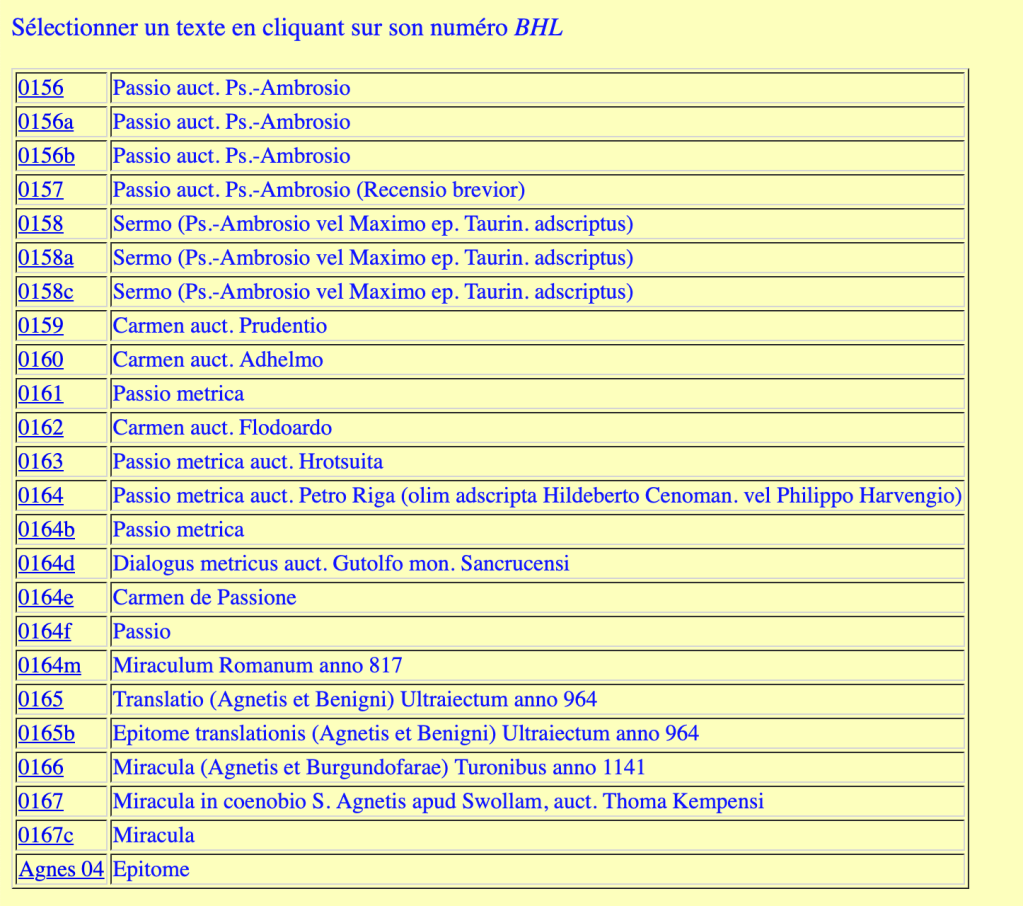
My next step is to explore the BHL Bibliography to find what information may be available to me about St. Agnes there. Her Latinized name is simply Agnes, which is useful. When I search for Agnes, four different saints appear, but my Agnes, Agnes v. m. Romae is among them. And she has quite a few sources available!

http://bhlms.fltr.ucl.ac.be/Nquerysaintrubrique.cfm?code_dossier=Agnes%2004&rubrique=Agnes%20v%2E%20m%2E%20Romae

Bibliography

BHL 0156 — Passio auct. Ps.-Ambrosio

“Inc.: Servus Christi Ambrosius virginibus sacris. Diem festum ss. virginis celebremus

BLH 0156a — Passio auct. Ps.-Ambrosio

“Inc.: Servus Christi Ambrosius virginibus sacris. Diem festum ss. virginis celebremus

BHL 0156b — Passio auct. Ps.-Ambrosio

“Inc.: Servus Christi Ambrosius virginibus sacris. Diem festum ss. virginis celebremus

BHL 0157 — Passio auct. Ps.-Ambrosio (Recenssio brevior)

“Inc.: Servus Christi Ambrosius ad aedificationem virginum qualiter passa sit Agnes

BHL 0158 — Sermo (Ps.-Ambrosio vel Maximo ep. Taurin. adscriptus)

“Inc.: Cum in toto mundo virgineus flos Mariae

BHL 0158a — Sermo (Ps.-Ambrosio vel Maximo ep. Taurin. adscriptus)

“Inc.: Cum in toto mundo virgineus flos Mariae

BHL 0158c — Sermo (Ps.-Ambrosio vel Maximo ep. Taurin. adscriptus)

“Inc.: Immaculatus Dominus immaculatam sibi famulam

BHL 0159 — Carmen auct. Prudentio

“Inc.: Agnes sepulchrum est Romulea in domo

BHL 0160 — Carmen auct. Adhelmo

“Inc.: Floruit in mundo quaedam virguncula

BHL 0161 — Passio metrica

“Inc. prol.: Iam vulgata licet maneant exempla salutis — Inc.: Tertia post decimam fieret cum virginis aetas”

BHL 0162 — Carmen auct. Flodoardo

“Inc.: Inclita nobilitat venerandae virginis…”

BHL 0163 — Passio metrica auct. Hrotsuita

“Inc.: Virgo quae vanas mundi pompas

BHL 0164 — Passio metrica auct. Petro Riga (olim adscripta Hildeberto Cenoman. vel Philippo Harvengio)

“Inc.: Agnes sacra sui pennam scriptoris inauret

BHL 0164b — Passio metrica

“Inc.: Virgae regalis de germine flos specialis

BHL 0164d — Dialogus metricus auct. Gutolfo mon. Sancrucensi

“Inc. prol.: Agna sequens agnum — Inc.: Quid modo cunctamur?”

BHL 0164e — Carmen de Passione

“Inc.: Agnes sponsa Dei virgo ss., salve

BHL 0164f — Passio

“Inc.: Expectat desiderio mens diu pressa scelere…”

BHL 0164m — Miraculum Romanum anno 817

“Inc. prol.: Ad honorem Iesu Christi, qui in sanctis suis — Inc.: Erat tunc temporis monasterium

BHL 0165 — Translatio (Agnetis et Benigni) Ultraiuectum anno 964

“Inc.: Tempore quo fervente Danorum crudelitate

BHL 0165b — Epitome translationis (Agnetis et Benigni) Ultraiectum anno 964

“Inc.: Tempore quo fervente Danorum crudelitate

BHL 0166 — Miracula (Agnetis et Burgundofarae) Turonibus anno 1141

“Inc. prol.: Universis s. ecclesiae praelatis… Rarus et iam nostris temporibus — Inc.: Farensis monasterii sanctimoniales Farae virginis corpus, martyris Agnetis caput”

BHL 0167 — Miracula in coenobio S. Agnetis apud Swollam, auct. Thoma Kempensi

“Inc.: Frater quidam domus nostrae capitis dolorem

BHL 0167c — Miracula

“Inc.: Igitur dum parentes b. Agnetis

English Translations

Finding full English translations is harder than I thought it would be. Perhaps I am not looking in the right places, or perhaps I am looking through the incorrect manner. Perhaps the problem is similar to the one I ran into with earlier stages — St. Agnes is so common and popular that useful sources get buried underneath the Bible studies, devotional websites, and encyclopedia entries.

The most frequent response I can find when searching for any of these texts is analyses and summaries of “The Eve of St. Agnes” by John Keats. This does seem like an interesting text, but it is a literary work irrelevant to the historical documents I am seeking.

I believe I found a translation of Prudentius’ carmen here, on what appears to be another daily devotional/liturgical website. I am uncertain of how viable the text actually is.

Thankfully, St. Agnes (and her sister-saint St. Emerentiana) are found in Michael Lapidge’s The Roman Martyrs: Introduction, Translations, and Commentary  beginning on page 348. Hopefully more will soon turn up as I continue searching and move forward with my research.

Research Assignment 1.2

My next task in my search for Saint Agnes is to locate her account in the Acta Sanctorum. Because my Latin is limited, I will be limited in what I can transpose from the raw text. However, this will still be an incredibly useful source.

We begin with St. Agnes’ feast day, or “dies natalist” — which happened to be a week ago, January 21.

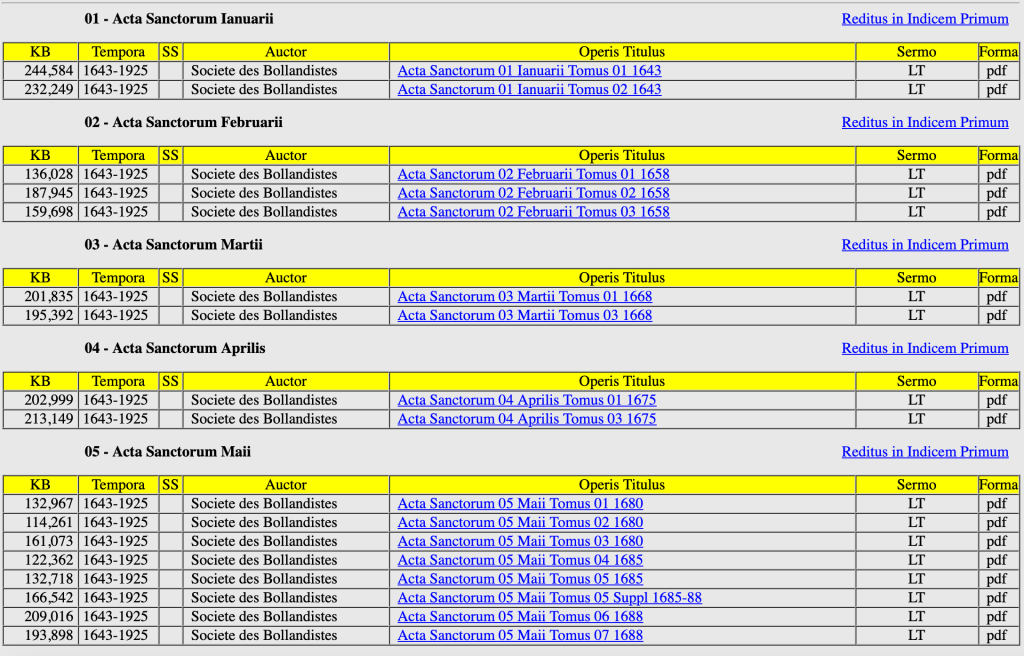
There are only two entries for January, thankfully, so I am hopeful to find Agnes in the second volume.

…Then I discovered that, while my choice would have been correct, it seemed that a demon had taken hold of my internet connection, refusing me to the view the life of the great saint. I was not deterred, however, and sought out another manner of accessing the text of the Acta Sanctorum.

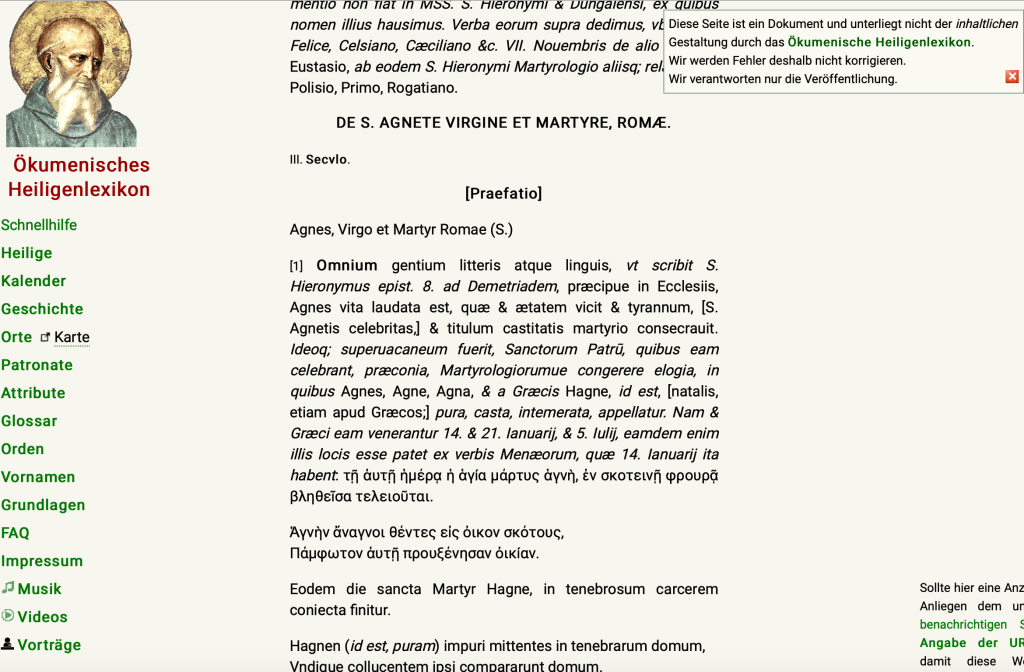
After much persistence and disappointment, I found a rather lackluster but available source in a German website that had compiled the text.

And there I found her here: https://www.heiligenlexikon.de/ActaSanctorum/21.Januar.html

It is worth noting that this website includes a disclaimer:

Diese Seite ist ein Dokument und unterliegt nicht der inhaltlichen Gestaltung durch das Ökumenische Heiligenlexikon.
Wir werden Fehler deshalb nicht korrigieren.
Wir verantworten nur die Veröffentlichung.

In English: “This page is a document and is not subject to the content of the Ecumenical Encyclopedia of Saints.
We will therefore not correct mistakes.
We are only responsible for the publication.”

That was somewhat disheartening. I also struggled to make sense of the text in this format. Thankfully, Dr. Wielfaert sent me an alternative link which took me to a much more easily navigable text.

I swiftly downloaded the pdf that contained her dies naturalis here: https://archive.org/details/actasanctorum02unse/page/740/mode/2up

An Outline of Saint Agnes in Acta Sanctorum

Researcher’s Note: My Latin is incredibly limited, and the aged script will certainly trip me up in places, but I will do my best to not only transcribe the Latin headings but also translate them where I can, with a bit of extra help from Google. I realize this may sound like an abomination to those of you who actually know Latin, in which case I ask, please don’t judge me. Rather, ask St. Lucia to grant me illumination in this area so I can get better at it, or so that I can be dissuaded from attempting any further.

De S. Agnete Virgine Et Martyre, Romae. “Of St. Agnes, Virgin and Martyr of Rome.”

Vita S. Agnetis, Auctore S. Ambrosio. “The Life of St. Agnes, authored by St. Ambrose.”

Caput I: S. Agnes P. V. Filio Nubere Recusat. “Chapter I: St. Agnes … Refuses to Marry the Son.” I could not find the meaning of “P. V.”, but I am highly limited by my linguistic skills (or lack thereof).

Caput II: Lupanari Flammisque Superior, Gladia Percutitur. Something like “Chapter II: The Brothel and the Superior (?) Flame, Glad to be Persecuted.” This translation is more of a reach for me, and thus very stilted. I found that “Lupani” usually refers to a brothel, which would align with my knowledge of the saint’s life, so I believe that Lupanari is another form of the word. “Gladia Percuitur” seems to mean something along the lines of “Glad to be Hit,” but I felt “Persecuted” fit the meaning more.

Caput III: S. Emerentiunae Caedes. Constantio Conversio. “Chapter III: The Slaughter of St. Emerentiana. The Conversion of Constantine.” This chapter is found within the vita of St. Agnes, because St. Emerentiana, according to traditions that I read about in the prior assignment, is the purported foster-sister of St. Agnes. She was martyred two days after Agnes, on January 23rd. This account is apparently followed by the discussion of the conversion of Constantine, who would favor the Church rather than persecute.

Eiusdem Acta Ex Menaeis Graec. “The Acts of the Same from the Menaean Greece(?).” These last two words gave me a great deal of trouble, so I enlisted the help of a more Latin-savvy friend (shoutout to Ashley Walker). There appears to be some Greek text within this chapter, which may be what this is referring to.

De Reliquiis S. Agnetis. “Of The Relics (Survivors) of St. Agnes.”

II. Reliquiae S. Agnetis Ultrajecti. “The Remains of St. Agnes…” I could not make sense of this last word, but I believe it is a further delineation of the kinds or locations of relics that St. Agnes left behind.

III. Aliquae Eiusdem Reliquia in Gallia. “Some of the Same Relics in Gaul (France).”

Historia Inventionis Et Translationis SS. Agnetis Et Benigni Episc. E. Gallia Ultrajectum ex Veteri ms. S. Pauli Ultrajecti. “History of the Inventions and Translations of Saints Agnes and Benignus, … of Gaul (France) … Old Manuscript of St. Pauli…” The world “Ultrajectum” still eludes me, but I do believe I can identify the aforementioned St. Benignus. He was a 3rd century martyr who is believed to have been a missionary priest of sorts to France. He was martyred in Dijon. However, I do not know (yet) what his connection is to St. Agnes.

Caput I: Reliquiae SS. Agnetis et Benigni Defossir Revelautur, Amolwino Rustico. “Chapter I: The Revelation of the Excavations of the Relics of Saints Agnes and Benignus … Farm”

Caput II: Reliquiae Inventae a Lomberto Presbytero. “Remains Found by the Elder Lomberto (or Elder of Lomberto?)”

Caput III: Festa Profanantes Puniti. “Holidays…Were Punished.” Sounds like a good (poorly translated) time!

Caput IV: Reliquiae Ultrajectum Translatae. “The […] Translations of Relics”

De Reliquiis S. Agnetis: Constantinopolim, Postea in Hispaniam Translatis. “The Relics of St. Agnes: Constantinople, Later Translated to Hispania (Spain).” Could also be “In later versions, Spain” or “Later Translations in/to Spain.”

Narratio Translationis Ex Antonio Vincentio Domenecca. “The Story of the Translations from Antonio Vincent Domenecca.” Domenecca might be a different word or place, but because I cannot find a translation for it, I am assuming that these three are all names, referring to one person.

De Miraculis S. Agnetis. “Of the Miracles of St. Agnes.”

Alia Miracula ex Thom. a Kempis Post Sev. 8, ad Novit. I. Ope S. Agnetis Pulsa Agritudo. “The Other Miracles from Thomas of Kempis […] I. The Help of St. Agnes in […] Distress.”

Pecunia Amissa Recuperata. “The Recovery of Lost Money.”

Alia Sanctae Beneficia. “Some Other Holy Benefits.”

<end of outline>

This was a unique experience, and I feel like once I dive into the text (once I find it in a translation I can actually read) I will learn much. My own inadequate translations are likely quite off, but I feel like I have already learned a fair amount. Mostly that I don’t remember much from my high school Latin classes. Next week, we’ll see where these leads take us!

Research Assignment 1.1

There are many saints that I have heard of, yet many that I do not actually know their stories. St. Agnes is one such saint.

17th century painting entitled St. Agnes, by Cesare Dandini. Public Domain. https://commons.wikimedia.org/wiki/File:Saint_Agnes_by_Cesare_Dandini.jpg#filelinks.

I began my research for this assignment by looking at a list on Wikipedia of early Christian saints and martyrs, for fear that I would stray from the intended time period of the assignment if I did not make sure to start there. I then hit upon St. Agnes within that list. I had heard her name many times, but never looked into her story. Having chosen my topic, I then began researching this saintly woman.

Since I was already on Wikipedia, I started with what information that the site could give me, though it may be fallible.

Agnes of Rome is a saint venerated in not only the Catholic Church, but the Eastern Orthodox Church, the Anglican Communion, and the Lutheran church. She is so prominent that she is mentioned by name in the Canon of the Mass.

To summarize her biography, Agnes was a young girl who was born into a Roman noble family that practiced Christianity in AD 291. She was beautiful and attracted many suitors, but she refused to marry because she was committed to preserving her purity. According to the legend, those suitors were offended at their rejection, and thus turned her in for being a Christian. She was sentenced to be dragged naked through the streets of Rome to a brothel, but several accounts tell of miracles that protected her purity. One account states that her hair grew to cover her body when she prayed. Another says that the men who tried to rape her were instantly struck blind. She was released after praying for the healing and revival of the prefect’s dead son, but eventually tried again and sentenced to death. They tried to have her burned at the stake, but the wood would not burn or the flames would not touch her (depending on the account). Ultimately, she was stabbed and/or beheaded by a Roman officer overseeing the event. She was only 12, dying on January 21, 304. Thus, her feast day is celebrated on January 21.

It is slightly unclear where she was originally buried, and there is no story included of her translation, but it is mentioned that her bones are now preserved in the church of Sant’Agnese four le mura, in Rome. However, her skull is preserved and displayed separately, in the church of Sant’Agnese in Agone, a church in a different area of Rome.

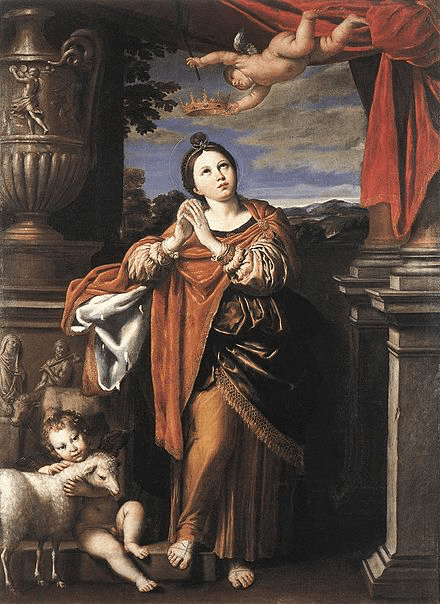
Wikipedia tells me that Agnes is the patron saint of those seeking chastity and purity, as well as the matron saint of young girls. It also vaguely alludes to “rituals” found in folklore that girls used to perform on Saint Agnes’ Eve that somehow allowed them to discover their future husbands. She is also usually depicted with a lamb, a symbol of her purity.

Saint Agnes by Domenichino, c. 1620. Public Domain. https://en.wikipedia.org/wiki/Agnes_of_Rome.

Notably, the article also mentions that an early account of Agnes’ death is found in the writings of St. Ambrose. It is believed she was already venerated as a saint during his lifetime. This would be an interesting primary source to explore on the subject.

However, for now, I should back up to see what other references Google can provide me, and find out how reliable what I have learned from Wikipedia appears to be.

The Search for Saint Agnes of Rome

Following the format of others, I will post the first two pages of entries of the 7,340,000 results that Google provided me.

  1. St. Agnes – Saints & Angels – Catholic Online
  2. Agnes of Rome – Wikipedia
  3. Saint Agnes – Franciscan Media
  4. Who Was Saint Agnes? | The Church of Saint Agnes
  5. Agnes of Rome | Saints Resource
  6. Saint Agnes | Legend & Story | Britannica
  7. Agnes of Rome – New World Encyclopedia
  8. CATHOLIC ENCYCLOPEDIA: St. Agnes of Rome – New Advent
  9. Saint Agnes | Encyclopedia.com
  10. St. Agnes of Rome
  11. Saint Agnes of Rome – Virgin and Martyr – Learn Religions
  12. Profile and Biography of Catholic Saint Agnes of Rome
  13. St. Agnes of Rome | Antiochian Orthodox Christian Archdiocese
  14. Saint Agnes – My Catholic Life!
  15. Virginmartyr Agnes of Rome – Orthodox Church in America
  16. Saint Agnes of Rome – Newman Connection – Effingham, IL
  17. St. Agnes of Rome Biography Feast Day – January 21 – Saint …
  18. St. Agnes – Catholic News Agency
  19. Saint Agnes of Rome | CatholicSaints.Info
  20. St. Agnes: story of a virgin and martyr – Holyart.com Blog

Based on a cursory viewing of these pages, I group them thus:

Encyclopedias

Entries 1, 2, 5, 6, 7, 8, 9, 11, 12, 15, and 19 are all from sites that basically function as encyclopedic reference resources, usually of saints in general. However, entry 11 and 12 are from a site that seems to cover all major world religions in a broad scope.

With further reading, there are some variations in the length, depth, and details of these versions of St. Agnes’ life, but nothing major. These are useful, if tracking down those minute threads becomes my focus, but they are largely the same.

“Daily Reflections” Sites

Entry 3, 13, 14, 17, 18, and 20 are from websites that either describe themselves as news outlets, devotional sites, or blogs, but they all offer similar information. They are less detailed than the encyclopedic sources, and they usually contain long paragraphs meant to be devotional or thought-provoking. That is not particularly useful for academic research in terms of biography, but it is useful for studying how she is remembered and venerated today.

Others

Entry 4 is somewhat encyclopedic in nature, but overly simplified because it is written for Catholic elementary and/or middle schools by a company that sells Catholic school curriculum. Entry 16 is from an organization that brings Catholic college students together, similar to YoungLife or Campus Crusade. Its content is similar to that of a brief biography of St. Agnes.

In Summation

The most useful sources are the encyclopedic texts that offer references to the primary and secondary sources of their tradition. It seems that my next stop should be the writings of St. Ambrose on St. Agnes. After that, entry 8 gave me other sources to look for, including the writings of Pope Damasus, Prudentius, the Agnes beat virginis, and The Acts of the Matyrdom of St. Agnes.

Design a site like this with WordPress.com
Get started