There are many saints that I have heard of, yet many that I do not actually know their stories. St. Agnes is one such saint.
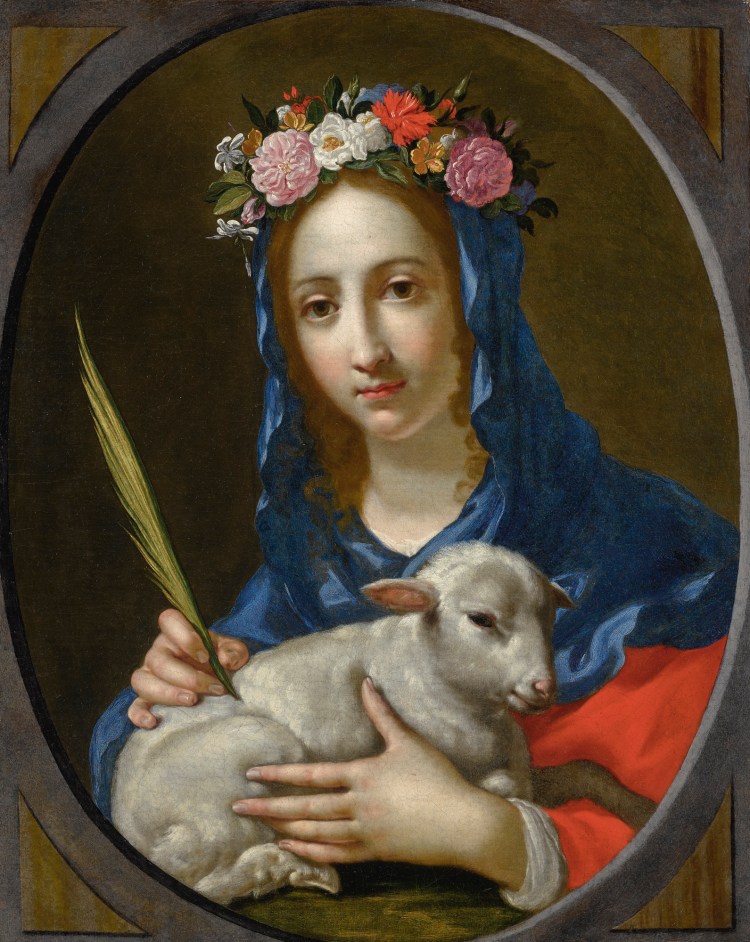
17th century painting entitled St. Agnes, by Cesare Dandini. Public Domain. https://commons.wikimedia.org/wiki/File:Saint_Agnes_by_Cesare_Dandini.jpg#filelinks.
I began my research for this assignment by looking at a list on Wikipedia of early Christian saints and martyrs, for fear that I would stray from the intended time period of the assignment if I did not make sure to start there. I then hit upon St. Agnes within that list. I had heard her name many times, but never looked into her story. Having chosen my topic, I then began researching this saintly woman.
Since I was already on Wikipedia, I started with what information that the site could give me, though it may be fallible.
Agnes of Rome is a saint venerated in not only the Catholic Church, but the Eastern Orthodox Church, the Anglican Communion, and the Lutheran church. She is so prominent that she is mentioned by name in the Canon of the Mass.
To summarize her biography, Agnes was a young girl who was born into a Roman noble family that practiced Christianity in AD 291. She was beautiful and attracted many suitors, but she refused to marry because she was committed to preserving her purity. According to the legend, those suitors were offended at their rejection, and thus turned her in for being a Christian. She was sentenced to be dragged naked through the streets of Rome to a brothel, but several accounts tell of miracles that protected her purity. One account states that her hair grew to cover her body when she prayed. Another says that the men who tried to rape her were instantly struck blind. She was released after praying for the healing and revival of the prefect’s dead son, but eventually tried again and sentenced to death. They tried to have her burned at the stake, but the wood would not burn or the flames would not touch her (depending on the account). Ultimately, she was stabbed and/or beheaded by a Roman officer overseeing the event. She was only 12, dying on January 21, 304. Thus, her feast day is celebrated on January 21.
It is slightly unclear where she was originally buried, and there is no story included of her translation, but it is mentioned that her bones are now preserved in the church of Sant’Agnese four le mura, in Rome. However, her skull is preserved and displayed separately, in the church of Sant’Agnese in Agone, a church in a different area of Rome.
Wikipedia tells me that Agnes is the patron saint of those seeking chastity and purity, as well as the matron saint of young girls. It also vaguely alludes to “rituals” found in folklore that girls used to perform on Saint Agnes’ Eve that somehow allowed them to discover their future husbands. She is also usually depicted with a lamb, a symbol of her purity.
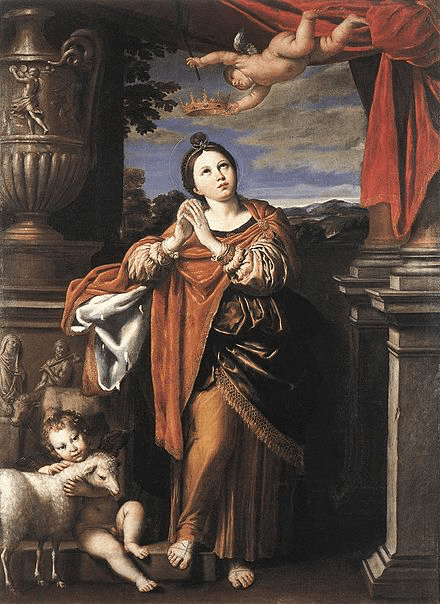
Notably, the article also mentions that an early account of Agnes’ death is found in the writings of St. Ambrose. It is believed she was already venerated as a saint during his lifetime. This would be an interesting primary source to explore on the subject.
However, for now, I should back up to see what other references Google can provide me, and find out how reliable what I have learned from Wikipedia appears to be.
The Search for Saint Agnes of Rome
Following the format of others, I will post the first two pages of entries of the 7,340,000 results that Google provided me.
- St. Agnes – Saints & Angels – Catholic Online
- Agnes of Rome – Wikipedia
- Saint Agnes – Franciscan Media
- Who Was Saint Agnes? | The Church of Saint Agnes
- Agnes of Rome | Saints Resource
- Saint Agnes | Legend & Story | Britannica
- Agnes of Rome – New World Encyclopedia
- CATHOLIC ENCYCLOPEDIA: St. Agnes of Rome – New Advent
- Saint Agnes | Encyclopedia.com
- St. Agnes of Rome
- Saint Agnes of Rome – Virgin and Martyr – Learn Religions
- Profile and Biography of Catholic Saint Agnes of Rome
- St. Agnes of Rome | Antiochian Orthodox Christian Archdiocese
- Saint Agnes – My Catholic Life!
- Virginmartyr Agnes of Rome – Orthodox Church in America
- Saint Agnes of Rome – Newman Connection – Effingham, IL
- St. Agnes of Rome Biography Feast Day – January 21 – Saint …
- St. Agnes – Catholic News Agency
- Saint Agnes of Rome | CatholicSaints.Info
- St. Agnes: story of a virgin and martyr – Holyart.com Blog
Based on a cursory viewing of these pages, I group them thus:
Encyclopedias
Entries 1, 2, 5, 6, 7, 8, 9, 11, 12, 15, and 19 are all from sites that basically function as encyclopedic reference resources, usually of saints in general. However, entry 11 and 12 are from a site that seems to cover all major world religions in a broad scope.
With further reading, there are some variations in the length, depth, and details of these versions of St. Agnes’ life, but nothing major. These are useful, if tracking down those minute threads becomes my focus, but they are largely the same.
“Daily Reflections” Sites
Entry 3, 13, 14, 17, 18, and 20 are from websites that either describe themselves as news outlets, devotional sites, or blogs, but they all offer similar information. They are less detailed than the encyclopedic sources, and they usually contain long paragraphs meant to be devotional or thought-provoking. That is not particularly useful for academic research in terms of biography, but it is useful for studying how she is remembered and venerated today.
Others
Entry 4 is somewhat encyclopedic in nature, but overly simplified because it is written for Catholic elementary and/or middle schools by a company that sells Catholic school curriculum. Entry 16 is from an organization that brings Catholic college students together, similar to YoungLife or Campus Crusade. Its content is similar to that of a brief biography of St. Agnes.
In Summation
The most useful sources are the encyclopedic texts that offer references to the primary and secondary sources of their tradition. It seems that my next stop should be the writings of St. Ambrose on St. Agnes. After that, entry 8 gave me other sources to look for, including the writings of Pope Damasus, Prudentius, the Agnes beat virginis, and The Acts of the Matyrdom of St. Agnes.
 Omnia Disce
