My next task in my search for Saint Agnes is to locate her account in the Acta Sanctorum. Because my Latin is limited, I will be limited in what I can transpose from the raw text. However, this will still be an incredibly useful source.
We begin with St. Agnes’ feast day, or “dies natalist” — which happened to be a week ago, January 21.
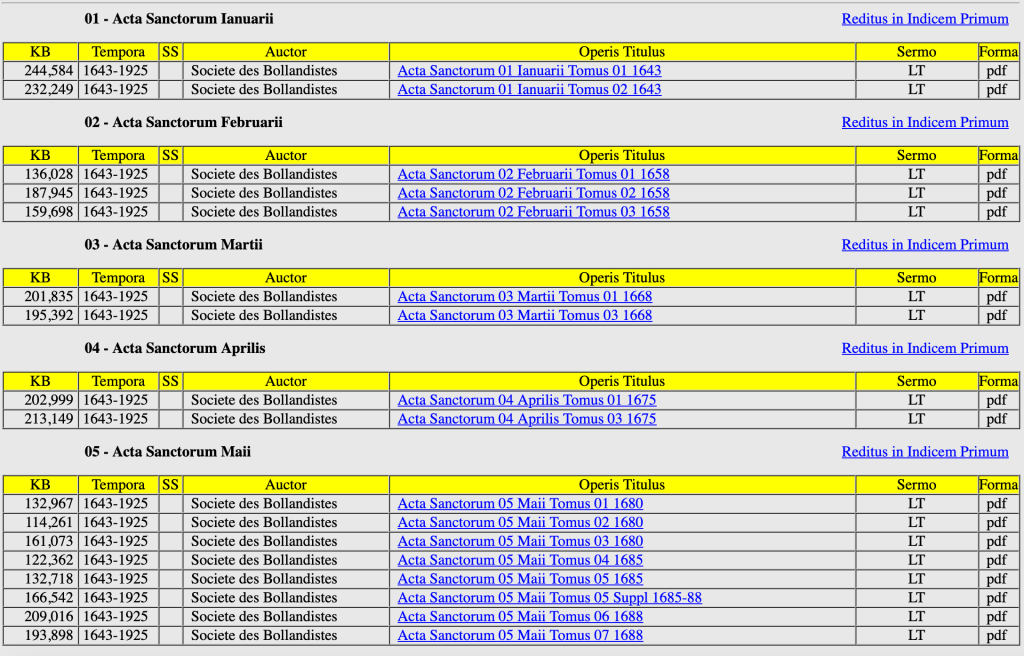
There are only two entries for January, thankfully, so I am hopeful to find Agnes in the second volume.
…Then I discovered that, while my choice would have been correct, it seemed that a demon had taken hold of my internet connection, refusing me to the view the life of the great saint. I was not deterred, however, and sought out another manner of accessing the text of the Acta Sanctorum.
After much persistence and disappointment, I found a rather lackluster but available source in a German website that had compiled the text.
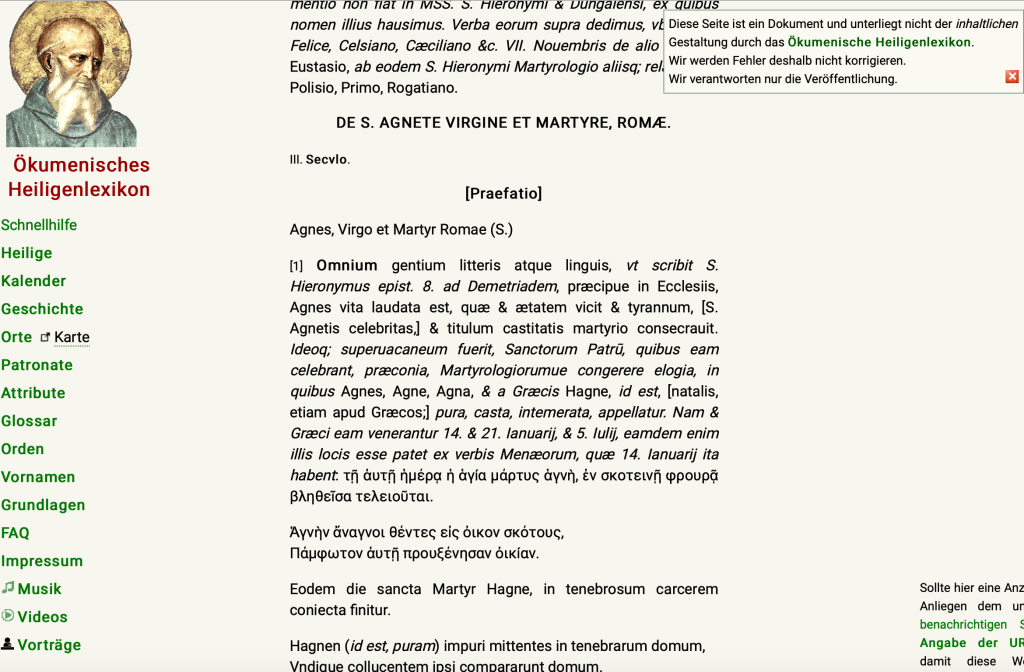
And there I found her here: https://www.heiligenlexikon.de/ActaSanctorum/21.Januar.html
It is worth noting that this website includes a disclaimer:
Diese Seite ist ein Dokument und unterliegt nicht der inhaltlichen Gestaltung durch das Ökumenische Heiligenlexikon.
Wir werden Fehler deshalb nicht korrigieren.
Wir verantworten nur die Veröffentlichung.
In English: “This page is a document and is not subject to the content of the Ecumenical Encyclopedia of Saints.
We will therefore not correct mistakes.
We are only responsible for the publication.”
That was somewhat disheartening. I also struggled to make sense of the text in this format. Thankfully, Dr. Wielfaert sent me an alternative link which took me to a much more easily navigable text.
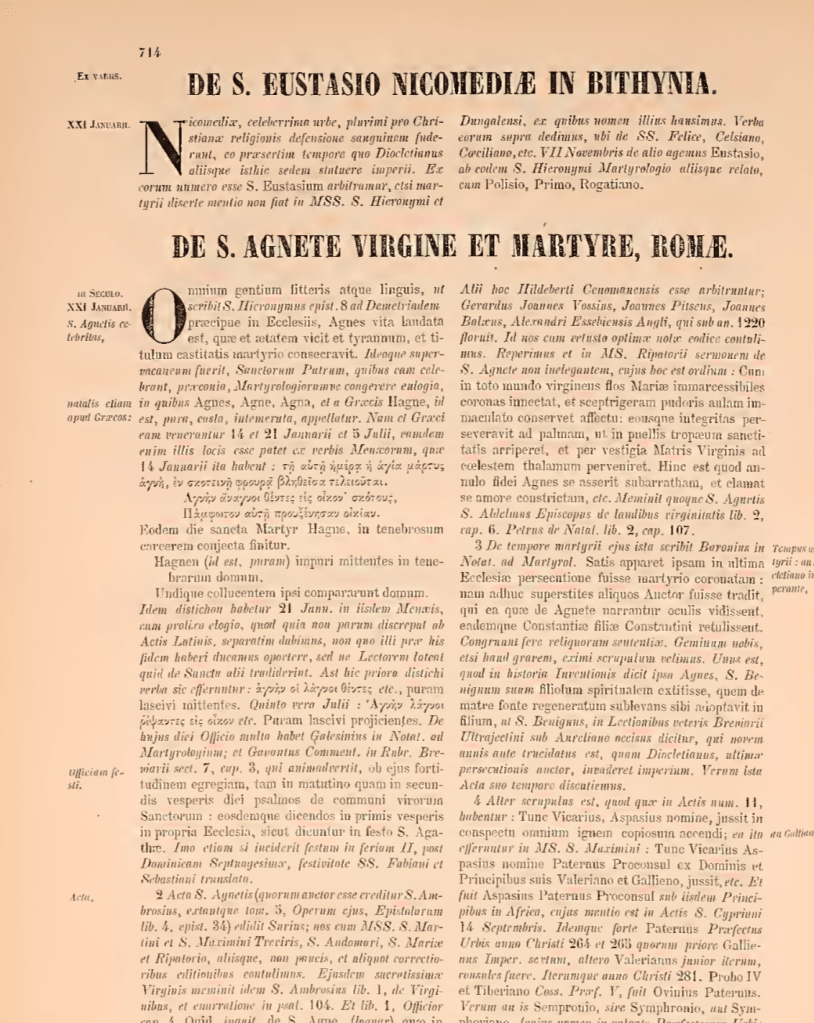
I swiftly downloaded the pdf that contained her dies naturalis here: https://archive.org/details/actasanctorum02unse/page/740/mode/2up
An Outline of Saint Agnes in Acta Sanctorum
Researcher’s Note: My Latin is incredibly limited, and the aged script will certainly trip me up in places, but I will do my best to not only transcribe the Latin headings but also translate them where I can, with a bit of extra help from Google. I realize this may sound like an abomination to those of you who actually know Latin, in which case I ask, please don’t judge me. Rather, ask St. Lucia to grant me illumination in this area so I can get better at it, or so that I can be dissuaded from attempting any further.
De S. Agnete Virgine Et Martyre, Romae. “Of St. Agnes, Virgin and Martyr of Rome.”
Vita S. Agnetis, Auctore S. Ambrosio. “The Life of St. Agnes, authored by St. Ambrose.”
Caput I: S. Agnes P. V. Filio Nubere Recusat. “Chapter I: St. Agnes … Refuses to Marry the Son.” I could not find the meaning of “P. V.”, but I am highly limited by my linguistic skills (or lack thereof).
Caput II: Lupanari Flammisque Superior, Gladia Percutitur. Something like “Chapter II: The Brothel and the Superior (?) Flame, Glad to be Persecuted.” This translation is more of a reach for me, and thus very stilted. I found that “Lupani” usually refers to a brothel, which would align with my knowledge of the saint’s life, so I believe that Lupanari is another form of the word. “Gladia Percuitur” seems to mean something along the lines of “Glad to be Hit,” but I felt “Persecuted” fit the meaning more.
Caput III: S. Emerentiunae Caedes. Constantio Conversio. “Chapter III: The Slaughter of St. Emerentiana. The Conversion of Constantine.” This chapter is found within the vita of St. Agnes, because St. Emerentiana, according to traditions that I read about in the prior assignment, is the purported foster-sister of St. Agnes. She was martyred two days after Agnes, on January 23rd. This account is apparently followed by the discussion of the conversion of Constantine, who would favor the Church rather than persecute.
Eiusdem Acta Ex Menaeis Graec. “The Acts of the Same from the Menaean Greece(?).” These last two words gave me a great deal of trouble, so I enlisted the help of a more Latin-savvy friend (shoutout to Ashley Walker). There appears to be some Greek text within this chapter, which may be what this is referring to.
De Reliquiis S. Agnetis. “Of The Relics (Survivors) of St. Agnes.”
II. Reliquiae S. Agnetis Ultrajecti. “The Remains of St. Agnes…” I could not make sense of this last word, but I believe it is a further delineation of the kinds or locations of relics that St. Agnes left behind.
III. Aliquae Eiusdem Reliquia in Gallia. “Some of the Same Relics in Gaul (France).”
Historia Inventionis Et Translationis SS. Agnetis Et Benigni Episc. E. Gallia Ultrajectum ex Veteri ms. S. Pauli Ultrajecti. “History of the Inventions and Translations of Saints Agnes and Benignus, … of Gaul (France) … Old Manuscript of St. Pauli…” The world “Ultrajectum” still eludes me, but I do believe I can identify the aforementioned St. Benignus. He was a 3rd century martyr who is believed to have been a missionary priest of sorts to France. He was martyred in Dijon. However, I do not know (yet) what his connection is to St. Agnes.
Caput I: Reliquiae SS. Agnetis et Benigni Defossir Revelautur, Amolwino Rustico. “Chapter I: The Revelation of the Excavations of the Relics of Saints Agnes and Benignus … Farm”
Caput II: Reliquiae Inventae a Lomberto Presbytero. “Remains Found by the Elder Lomberto (or Elder of Lomberto?)”
Caput III: Festa Profanantes Puniti. “Holidays…Were Punished.” Sounds like a good (poorly translated) time!
Caput IV: Reliquiae Ultrajectum Translatae. “The […] Translations of Relics”
De Reliquiis S. Agnetis: Constantinopolim, Postea in Hispaniam Translatis. “The Relics of St. Agnes: Constantinople, Later Translated to Hispania (Spain).” Could also be “In later versions, Spain” or “Later Translations in/to Spain.”
Narratio Translationis Ex Antonio Vincentio Domenecca. “The Story of the Translations from Antonio Vincent Domenecca.” Domenecca might be a different word or place, but because I cannot find a translation for it, I am assuming that these three are all names, referring to one person.
De Miraculis S. Agnetis. “Of the Miracles of St. Agnes.”
Alia Miracula ex Thom. a Kempis Post Sev. 8, ad Novit. I. Ope S. Agnetis Pulsa Agritudo. “The Other Miracles from Thomas of Kempis […] I. The Help of St. Agnes in […] Distress.”
Pecunia Amissa Recuperata. “The Recovery of Lost Money.”
Alia Sanctae Beneficia. “Some Other Holy Benefits.”
<end of outline>
This was a unique experience, and I feel like once I dive into the text (once I find it in a translation I can actually read) I will learn much. My own inadequate translations are likely quite off, but I feel like I have already learned a fair amount. Mostly that I don’t remember much from my high school Latin classes. Next week, we’ll see where these leads take us!
 Omnia Disce